-
Stochastic Optimization of Sorting Networks via Continuous Relaxations openreview.net
ICLR'19, 2019. [All Versions].
-
Abductive Commonsense Reasoning openreview.net
ICLR'20, 2020. [All Versions]. Abductive commonsense reasoning on large language models.
-
Program Guided Agent openreview.net
ICLR'20, 2020. [All Versions].
-
Watch-And-Help: A Challenge for Social Perception and Human-AI Collaboration openreview.net
ICLR'21, 2021. [All Versions].
-
Learning Energy-Based Models by Diffusion Recovery Likelihood openreview.net
ICLR'21, 2021. [All Versions]. [Code].
-
Learning to Perform Physics Experiments via Deep Reinforcement Learning openreview.net
ICLR'17, 2017. [All Versions].
-
NBDT: Neural-Backed Decision Trees openreview.net
ICLR'21, 2021. [All Versions]. [Code]. Machine learning applications such as finance and medicine demand accurate and justifiable predictions, barring most deep learning methods from use. In response, previous work combines decision trees with deep learning, yielding models…
-
HLSMAC: A New StarCraft Multi-Agent Challenge for High-Level Strategic Decision-Making openreview.net
AAMAS'26, 2026. [All Versions]. Benchmarks are crucial for assessing multi-agent reinforcement learning (MARL) algorithms. While StarCraft II-related environments have driven significant advances in MARL, existing benchmarks like SMAC focus primarily on micromanagement…
-
Balancing Constraints and Rewards with Meta-Gradient D4PG openreview.net
ICLR'21, 2021. [All Versions].
-
Meta-Q-Learning openreview.net
ICLR'20, 2020. [All Versions]. The milestone paper on context Meta-RL.
-
Score-Based Generative Modeling through Stochastic Differential Equations openreview.net
ICLR'21, 2021. [All Versions].
-
Physion: Evaluating Physical Prediction from Vision in Humans and Machines openreview.net
NeurIPS'21, 2021. [All Versions].
-
The KoLMogorov Test: Compression by Code Generation openreview.net
ICLR'25, 2025. [All Versions]. Compression is at the heart of intelligence. A theoretically optimal way to compress any sequence of data is to find the shortest program that outputs that sequence and then halts. However, such Kolmogorov compression is uncomputable, and code…
-
Metacontrol for Adaptive Imagination-Based Optimization openreview.net
ICLR'17, 2017. [All Versions].
-
Hierarchically Encapsulated Representation for Protocol Design in Self-Driving Labs openreview.net
ICLR'25, 2025. [All Versions]. [Project]. Self-driving laboratories have begun to replace human experimenters in performing single experimental skills or predetermined experimental protocols. However, as the pace of idea iteration in scientific research has been intensified by…
-
Solving Compositional Reinforcement Learning Problems via Task Reduction openreview.net
ICLR'21, 2021. [All Versions].
-
Infinigen Indoors: Photorealistic Indoor Scenes using Procedural Generation openaccess.thecvf.com
CVPR'24, 2024. [All Versions]. This work introduces Infinigen Indoors, a Blender-based procedural generator of photorealistic indoor scenes. It builds upon the existing Infinigen system, which focuses on natural scenes, but expands its coverage to indoor scenes by introducing a…
-
Infinite Photorealistic Worlds Using Procedural Generation openaccess.thecvf.com
CVPR'23, 2023. [All Versions]. [Website]. [Supplementary Text]. This paper introduces Infinigen, a procedural generator of photorealistic 3D scenes of the natural world. Infinigen is entirely procedural: every asset, from shape to texture, is generated from scratch via…
-
Visual Programming: Compositional Visual Reasoning Without Training openaccess.thecvf.com
CVPR'23, 2023. [All Versions]. VISPROG, a neuro-symbolic approach to solving complex and compositional visual tasks given natural language instructions, using the in-context learning ability of large language models to generate python-like modular programs, which are then…
-
ImageBind: One Embedding Space To Bind Them All openaccess.thecvf.com
CVPR'23, 2023. [All Versions]. [Project]. This work presents ImageBind, an approach to learn a joint embedding across six different modalities - images, text, audio, depth, thermal, and IMU data. The authors show that all combinations of paired data are not necessary to train…
-
Learning Triadic Belief Dynamics in Nonverbal Communication from Videos openaccess.thecvf.com
CVPR'21, 2021. [All Versions]. [Preprint]. This paper incorporates different nonverbal communication cues (e.g., gaze, human poses, and gestures) to represent, model, learn, and infer agents' mental states from pure visual inputs. Crucially, such a mental representation takes…
-
Computational Models of Emotion Inference in Theory of Mind: A Review and Roadmap onlinelibrary.wiley.com
Topics in Cognitive Science, 2019. [All Versions]. This paper proposes an intuitive theory framework to studying affective cognition—how humans reason about emotions—and derive a taxonomy of inferences within affective cognition. Using this taxonomy, the authors review formal…
-
Rational Use of Cognitive Resources: Levels of Analysis Between the Computational and the Algorithmic onlinelibrary.wiley.com
Topics in Cognitive Science, 2015. [All Versions]. An earlier version of the paper above.
-
Computational Rationality: Linking Mechanism and Behavior Through Bounded Utility Maximization onlinelibrary.wiley.com
Topics in Cognitive Science, 2014. [All Versions]. Introducing the computational rationality framework for including information-processing bounds in rational analyses, which emphasizes the incorporation of computational mechanism into the definition of rational action.
-
The AHA! Experience: Creativity Through Emergent Binding in Neural Networks onlinelibrary.wiley.com
Cognitive Science, 2012. [All Versions].
-
Graphical Language Games: Interactional Constraints on Representational Form onlinelibrary.wiley.com
Cognitive Science, 2007. [All Versions]. The first paper introducing the graphical language game.
-
What Is the Model in Model-Based Planning? onlinelibrary.wiley.com
Cognitive Science, 2021. [All Versions].
-
The Interactive Evolution of Human Communication Systems onlinelibrary.wiley.com
Cognitive Science, 2010. [All Versions]. Nicolas Fay's original paper on iconicity.
-
Inferring causal networks from observations and interventions onlinelibrary.wiley.com
Cognitive Science, 2010. [All Versions].
-
Use of current explanations in multicausal abductive reasoning onlinelibrary.wiley.com
Cognitive Science, 2001. [All Versions].
-
Representations in distributed cognitive tasks onlinelibrary.wiley.com
Cognitive Science, 1994. [All Versions].
-
Dual Space Search During Scientific Reasoning onlinelibrary.wiley.com
Cognitive Science, 1988. [All Versions]. The original paper on the dual space search as scientific thinking theory.
-
Restructuring revisited II. An information processing theory of restructuring and insight onlinelibrary.wiley.com
Scandinavian Journal of Psychology, 1984. [All Versions].
-
Restructuring revisited I. Summary and critique of the Gestalt theory of problem solving onlinelibrary.wiley.com
Scandinavian Journal of Psychology, 1984. [All Versions].
-
Learning overhypotheses with hierarchical Bayesian models onlinelibrary.wiley.com
Developmental Science, 2007. [All Versions].
-
CoCoX: Generating Conceptual and Counterfactual Explanations via Fault-Lines ojs.aaai.org
AAAI'20, 2020. [All Versions].
-
PHASE: PHysically-grounded Abstract Social Events for Machine Social Perception ojs.aaai.org
AAAI'21, 2021. [All Versions]. [Project].
-
Theory-Based Causal Transfer: Integrating Instance-Level Induction and Abstract-Level Structure Learning ojs.aaai.org
AAAI'20, 2020. [All Versions]. A computatinoal account on causal transfer.
-
Abduction-Based Explanations for Machine Learning Models ojs.aaai.org
AAAI'19, 2019. [All Versions]. The growing range of applications of Machine Learning (ML) in a multitude of settings motivates the ability of computing small explanations for predictions made. Small explanations are generally accepted as easier for human decision makers to…
-
The importance of mixed selectivity in complex cognitive tasks oar.princeton.edu
Nature, 2013. [All Versions]. The original paper introducing mixed selectivity with high-dimensional neural representations.
-
Asking goal-oriented questions and learning from answers nyuccl.org
CogSci'19, 2019. [All Versions].
-
How to Make More Published Research True ncbi.nlm.nih.gov
PLoS Medicine, 2014. [All Versions].
-
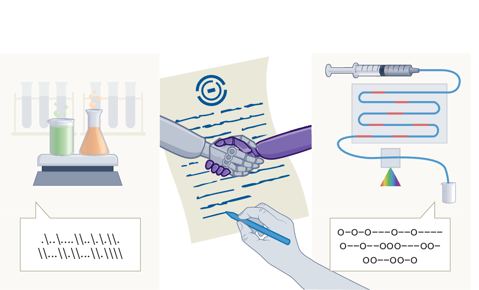
Reproducibility in automated chemistry laboratories using computer science abstractions nature.com
Nature Synthesis, 2024. [All Versions]. While abstraction is critical for the transferability of automated laboratory science in (bio)chemical and materials sciences, its improper implementation is a technical debt taken against the reproducibility of experimental results. Over…
-
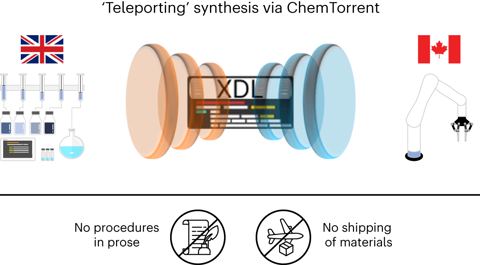
Universal chemical programming language for robotic synthesis repeatability nature.com
Nature Synthesis, 2024. [All Versions]. [Preprint]. The amount of chemical synthesis literature is growing quickly; however, it takes a long time to share and evaluate new processes among laboratories. This paper presents an approach that uses a universal chemical programming…
-
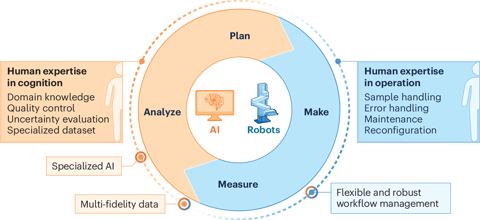
Balancing autonomy and expertise in autonomous synthesis laboratories nature.com
Nature Computational Science, 2025. [All Versions]. Autonomous synthesis laboratories promise to streamline the plan–make–measure–analyze iteration loop. Here, the authors comment on the barriers in the field, the promise of a human on-the-loop approach, and strategies for…
-
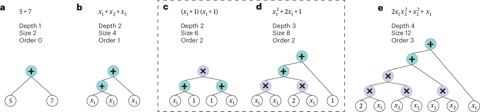
Quantifying artificial intelligence through algorithmic generalization nature.com
Nature Machine Intelligence, 2025. [All Versions]. The rapid development of artificial intelligence (AI) systems has created an urgent need for their scientific quantification. While their fluency across a variety of domains is impressive, AI systems fall short on tests…
-
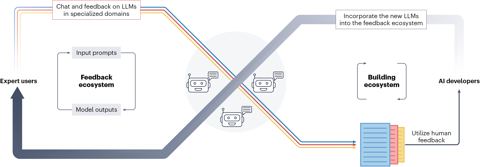
The future of open human feedback nature.com
Nature Machine Intelligence, 2025. [All Versions]. Human feedback on conversations with language models is central to how these systems learn about the world, improve their capabilities and are steered towards desirable and safe behaviours. However, this feedback is mostly…
-
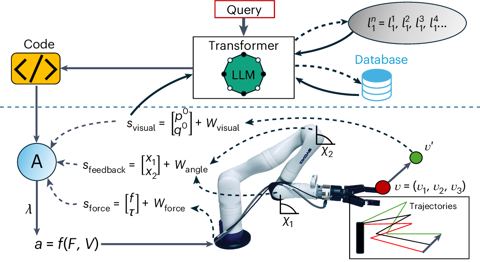
Embodied large language models enable robots to complete complex tasks in unpredictable environments nature.com
Nature Machine Intelligence, 2025. [All Versions]. Completing complex tasks in unpredictable settings challenges robotic systems, requiring a step change in machine intelligence. Sensorimotor abilities are considered integral to human intelligence. Thus, biologically inspired…
-
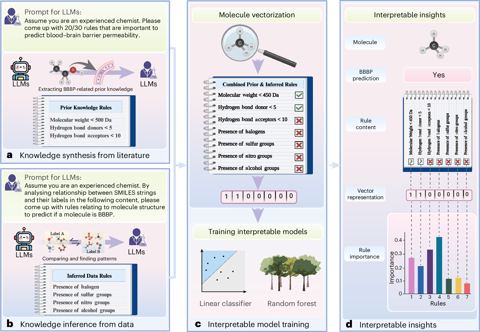
Large language models for scientific discovery in molecular property prediction nature.com
Nature Machine Intelligence, 2025. [All Versions]. Large language models (LLMs) are a form of artificial intelligence system encapsulating vast knowledge in the form of natural language. These systems are adept at numerous complex tasks including creative writing, storytelling…
-
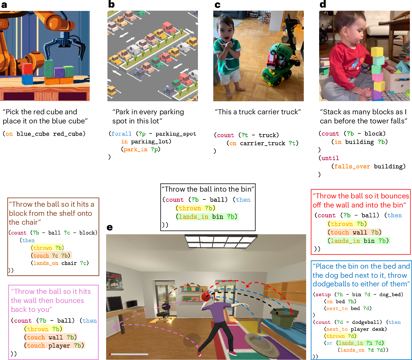
Goals as reward-producing programs nature.com
Nature Human Behavior, 2025. [All Versions]. [Project]. People are remarkably capable of generating their own goals, beginning with child’s play and continuing into adulthood. Despite considerable empirical and computational work on goals and goal-oriented behaviour, models are…
- next page of items loading…