Abduction-Based Explanations for Machine Learning Models
AAAI'19, 2019. [All Versions]. The growing range of applications of Machine Learning (ML) in a multitude of settings motivates the ability of computing small explanations for predictions made. Small explanations are generally accepted as easier for human decision makers to…
- from
- AGI & CoCoSci
- added
- 2026-10-10
- likes
- 0
similar
-
Beneficial and harmful explanatory machine learning link.springer.com
Machine Learning, 2021. [All Versions]. Given the recent successes of Deep Learning in AI there has been increased interest in the role and need for explanations in machine learned theories. A distinct notion in this context is that of Michie’s definition of ultra-strong…
-
Use of current explanations in multicausal abductive reasoning onlinelibrary.wiley.com
Cognitive Science, 2001. [All Versions].
-
Probabilistic alternatives to Bayesianism: the case of explanationism frontiersin.org
Frontiers in Psychology, 2015. [All Versions]. A non-Bayesian account of Abduction.
-
Explaining machine learning models with interactive natural language conversations using TalkToModel nature.com
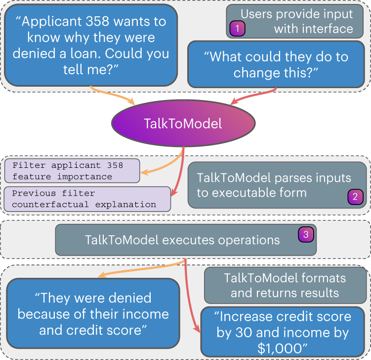
Nature Machine Intelligence, 2023. [All Versions]. Practitioners increasingly use machine learning (ML) models, yet models have become more complex and harder to understand. To understand complex models, researchers have proposed techniques to explain model predictions…
-
Probabilistic Sufficient Explanations ijcai.org
IJCAI'21, 2021. [All Versions]. Understanding the behavior of learned classifiers is an important task, and various black-box explanations, logical reasoning approaches, and model-specific methods have been proposed. This paper introduces probabilistic sufficient explanations…
-
Scientific Explanation plato.stanford.edu
Plato Stanford. A computational philosophy account on Scientific Explanation, a canonical application of Abduction.
AGI & CoCoSci › Papers > Abduction > Applications in AI: “AAAI'19, 2019. [All Versions]. The growing range of applications of Machine Learning (ML) in a multitude of settings motivates the ability of computing small explanations for predictions made. Small explanations are generally accepted as easier for human decision makers to…”