Reproducibility in automated chemistry laboratories using computer science abstractions
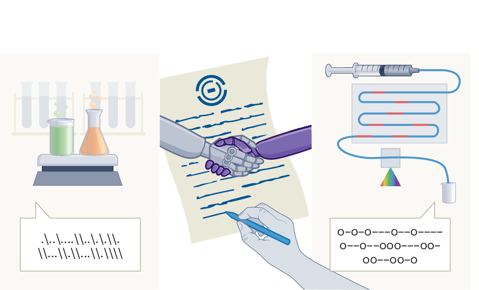
Nature Synthesis, 2024. [All Versions]. While abstraction is critical for the transferability of automated laboratory science in (bio)chemical and materials sciences, its improper implementation is a technical debt taken against the reproducibility of experimental results. Over…
- from
- AGI & CoCoSci
- added
- 2026-10-10
- likes
- 0
similar
-
-
Bridging the information gap in organic chemical reactions nature.com
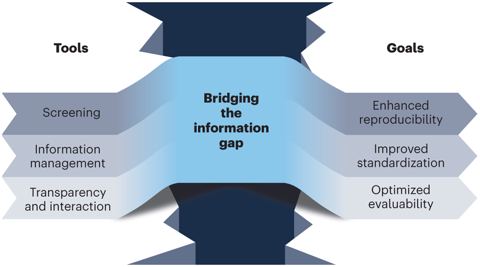
Nature Chemistry, 2024. [All Versions]. This perspective article formulates eight principles to improve data management in scientific publications relating to data standardization, reproducibility and evaluation, and encourage scientists to go beyond current publication…
-
Universal chemical programming language for robotic synthesis repeatability nature.com
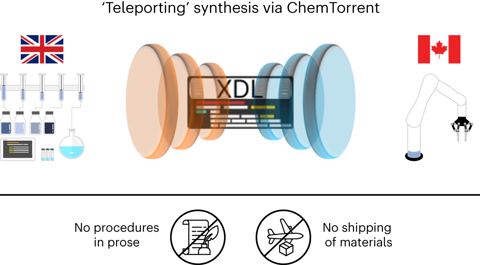
Nature Synthesis, 2024. [All Versions]. [Preprint]. The amount of chemical synthesis literature is growing quickly; however, it takes a long time to share and evaluate new processes among laboratories. This paper presents an approach that uses a universal chemical programming…
-
-
Balancing autonomy and expertise in autonomous synthesis laboratories nature.com
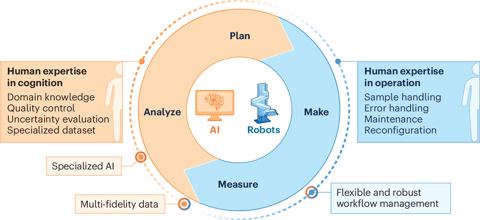
Nature Computational Science, 2025. [All Versions]. Autonomous synthesis laboratories promise to streamline the plan–make–measure–analyze iteration loop. Here, the authors comment on the barriers in the field, the promise of a human on-the-loop approach, and strategies for…
-
Automated extraction of chemical synthesis actions from experimental procedures nature.com
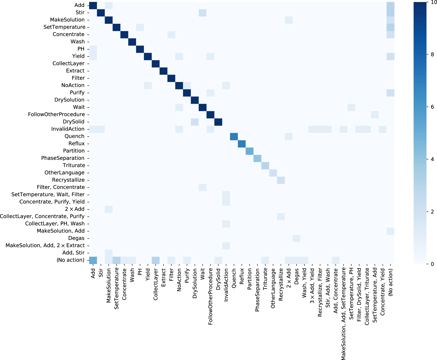
Nature Communications, 2020. [All Versions]. This paper presents a method to convert unstructured experimental procedures written in English to structured synthetic steps (action sequences) reflecting all the operations needed to successfully conduct the corresponding chemical…
AGI & CoCoSci › Papers > Domain Specific Language > Design Practises: “Nature Synthesis, 2024. [All Versions]. While abstraction is critical for the transferability of automated laboratory science in (bio)chemical and materials sciences, its improper implementation is a technical debt taken against the reproducibility of experimental results. Over…”