Balancing autonomy and expertise in autonomous synthesis laboratories
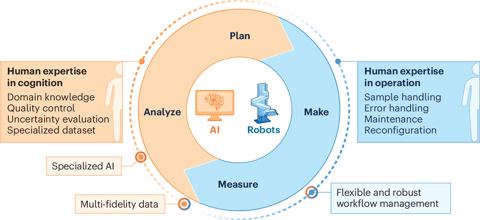
Nature Computational Science, 2025. [All Versions]. Autonomous synthesis laboratories promise to streamline the plan–make–measure–analyze iteration loop. Here, the authors comment on the barriers in the field, the promise of a human on-the-loop approach, and strategies for…
- from
- AGI & CoCoSci
- added
- 2026-10-10
- likes
- 0
similar
-
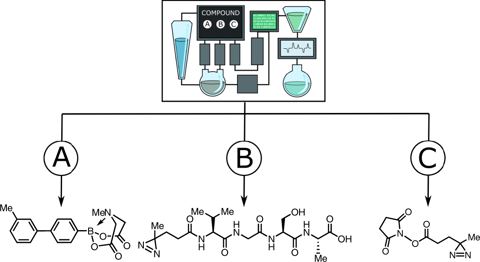
Convergence of multiple synthetic paradigms in a universally programmable chemical synthesis machine nature.com
Nature Chemistry, 2020. [All Versions]. [Preprint]. Although the automatic synthesis of molecules has been established, each reaction class uses bespoke hardware. This means that the connection of multi-step syntheses in a single machine to run many different protocols and…
-
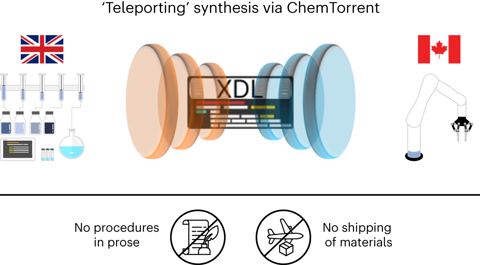
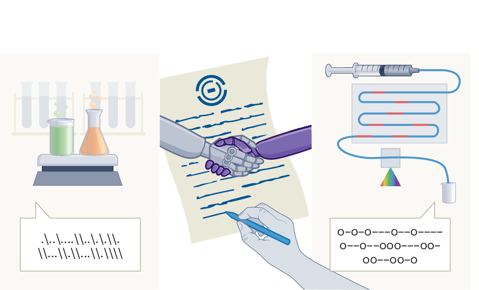
Universal chemical programming language for robotic synthesis repeatability nature.com
Nature Synthesis, 2024. [All Versions]. [Preprint]. The amount of chemical synthesis literature is growing quickly; however, it takes a long time to share and evaluate new processes among laboratories. This paper presents an approach that uses a universal chemical programming…
-
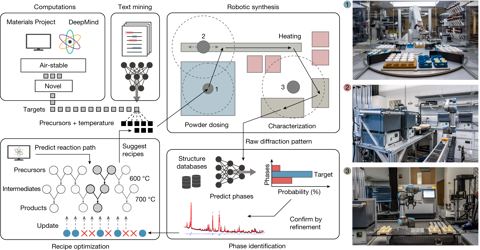
An autonomous laboratory for the accelerated synthesis of novel materials nature.com
Nature, 2023. [All Versions]. This paper introduces the A-Lab, an autonomous laboratory for the solid-state synthesis of inorganic powders. This platform uses computations, historical data from the literature, machine learning (ML) and active learning to plan and interpret the…
-
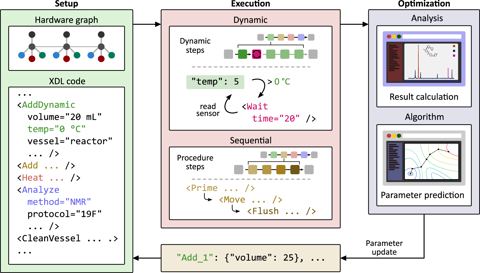
An integrated self-optimizing programmable chemical synthesis and reaction engine nature.com
Nature Communications, 2024. [All Versions]. Robotic platforms for chemistry are developing rapidly but most systems are not currently able to adapt to changing circumstances in real-time. This paper presents a dynamically programmable system capable of making, optimizing, and…
-
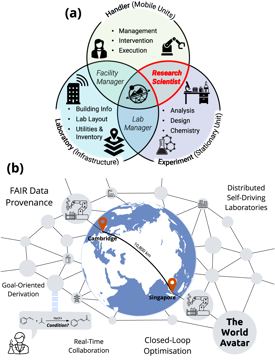
A dynamic knowledge graph approach to distributed self-driving laboratories nature.com
Nature Communications, 2024. [All Versions]. This work employs ontologies to capture data and material flows in design-make-test-analyse cycles, utilising autonomous agents as executable knowledge components to carry out the experimentation workflow. Data provenance is recorded…
-
Reproducibility in automated chemistry laboratories using computer science abstractions nature.com
Nature Synthesis, 2024. [All Versions]. While abstraction is critical for the transferability of automated laboratory science in (bio)chemical and materials sciences, its improper implementation is a technical debt taken against the reproducibility of experimental results. Over…
AGI & CoCoSci › Papers > Science Logology > Laboratory Automation: “Nature Computational Science, 2025. [All Versions]. Autonomous synthesis laboratories promise to streamline the plan–make–measure–analyze iteration loop. Here, the authors comment on the barriers in the field, the promise of a human on-the-loop approach, and strategies for…”