Alex Russell's Dos Game Programming in C for Beginners
DOS game programming tutorial series including a primer on C, graphics, animation, input handling and collision detection. This series contains a tutorial for making buffered input handling. Last chapter contains full source code of a Break Out game on DOS.
- from
- DOS
- added
- 2026-10-10
- likes
- 0
similar
-
Tricks of the Game-Programming Gurus - by Andre Lamothe, John Ratcliff and Denise Tyler amazon.com
Comprehensive DOS game development book about starting out. Topics include keyboard, mouse- and joystick input handling, creating 2D and 3D VGA graphics, raycaster rendering, sound and music, game algorithms, Interrupt Service Routines (ISR), timers, artificial intelligence…
-
The Artevida Game Programming Tutorials web.archive.org
Kevin Matz's almost book-length treatment of DOS system programming and VGA programming fundamentals using C/C++ and 80x86 assembly. Unfortunately it is incomplete and was abandoned since 2001.
-
PC Game Programmer's Encyclopedia web.archive.org
Collection of guides covering assembly, sound (Sound Blaster, Gravis UltraSound, PC Speaker, GameBlaster, Adlib), input, memory (EMS, XMS, DMA Transfers), PIT, VGA, SVGA, algorithms and file formats.
-
David Brackeen - 256-Color VGA Programming in C web.archive.org
Tutorial series to learn how to create graphics on DOS, written in 1996.
-
Sound Programming with PC Speaker - Chapter 23 of A to Z of C web.archive.org
PC speaker programming chapter of the "A to Z of C" book with source code.
-
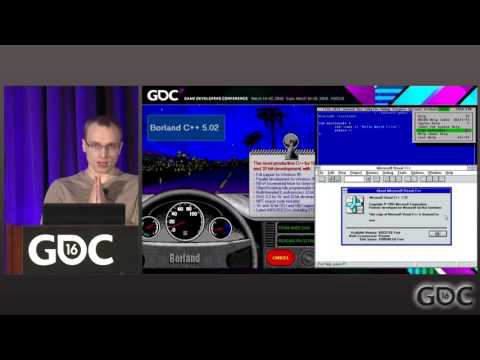
Porting Retro City Rampage to MS-DOS: From PS4 to 1.44MB Floppy youtube.com
GDC talk. Brian Provinciano's presentation on porting Retro City Rampage from PlayStation 4 to DOS. Topics include optimization, using interrupts, timing, PC speaker sound, joystick, memory management and fixed-point math.

DOS › Tutorials and programming resources > General: “DOS game programming tutorial series including a primer on C, graphics, animation, input handling and collision detection. This series contains a tutorial for making buffered input handling. Last chapter contains full source code of a Break Out game on DOS.”