Engineering Team Management
363 items from kdeldycke/awesome-engineering-team-management ★2,615
-
The Heilmeier Catechism darpa.mil
A simple set of question which helped DARPA evaluates research programs to generate big rewards by taking big risks.
-
Normalization of deviance danluu.com
Explores how the factors accounting for disasters accumulates unnoticed until it's too late. This has been studied on other fields, but not in software engineering.
-
5 Things I've Learned in 20 Years of Programming daedtech.com
“A programmer with 5 years of experienced has more industry tenure than half of the entire industry.” Also see this follow-up comment of 10 things I've learned after 35 years.
-
The Prosperous Software Consultant dabit3.medium.com
This article let you understand how an independent consultant operates.
-
Mistakes I've Made as an Engineering Manager css-tricks.com
Mistakes: “1) Thinking people give feedback the way they want to receive it; 2) Trying to do everything yourself; 3) Communicating something one time is enough; 4) You have to have everything together all the time.”
-
Learning Technical Writing Using the Engineering Method cs.tufts.edu
An alternative approach, involving a weekly meeting of a writing group. An interesting dynamic to gather feedback and experience.
-
Tips for Writing Technical Papers cs.stanford.edu
Another set of tips, specifically using the example of a technical paper describing an improvement of an algorithm.
-
I've Built Multiple Growth Teams. Here's Why I Won't Do It Again. conversionxl.com
“Few folks understand probability, and most executives don't care about the data, regardless of what it says.”
-
The Toxic Handler: Organizational Hero — and Casualty companiesalive.com
“toxic handler, a manager who voluntarily shoulders the sadness, frustration, bitterness, and anger that are endemic to organizational life. Although toxic handlers may be found at every level in organizations, many work near the top”.
-
To Get Good, Go After The Metagame commoncog.com
“Every sufficiently interesting game has a metagame above it. This is the game about the game. It is often called 'the meta'. (…) The meta is what you get after you master boring fundamentals. But observing the state of the current meta often reveals what boring fundamentals…
-
Sustainable Sources of Competitive Advantage collaborativefund.com
“The ability to learn faster than your competition; to empathize with customers more than your competition; to communicate more effectively than your competition; The willingness to fail more than your competition; to wait longer than your competition”.
-
A Few Rules collaborativefund.com
A formalized list of some wisdom you probably encountered elsewhere.
-
If management isn't a promotion, then engineering isn't a demotion charity.wtf
This essay deconstruct why management ends up being seen as a promotion, how its new acquired privileges and powers creates an implicit hierarchy, which in turns creates bad incentives because of loss aversion. At the end, the only way forwards is to change the organization's…
-
17 Reasons not to be a Manager charity.wtf
An article to discourage the faint-hearted recruits.
-
An Alternative Approach to Re-Orgs At Your Company caseyaccidental.com
“Trying not to repeat re-org mistakes, we started working on a structure that would make the re-org act like a feedback-fueled progress driven by the teams instead of by people above them.” This is an attempt to extract from the ground up signals pointing to inadequate…
-
A Career Cold Start Algorithm boz.com
The author developed an algorithm to ramp-up quickly when joining an existing team where he had a massive knowledge deficit and no pre-existing relationships.
-
Want to Know the Difference Between a CTO and a VP Engineering? bothsidesofthetable.com
Another way to look at thing: placing these roles along the “Process Orientation” and “Technical Capability” quadrants.
-
Choose Boring Technology boringtechnology.club
“Boring, in the sense that it's well understood.”
-
Avoiding Intellectual Phase Lock books.google.com
Anticipating an important result so much, humans by nature are susceptible to introduce subtle confirmation bias. To combat IPL, you might introduce random unknowns to suppress any attempt to game the system toward the object of your desire. I.e. avoid to cheat yourself to…
-
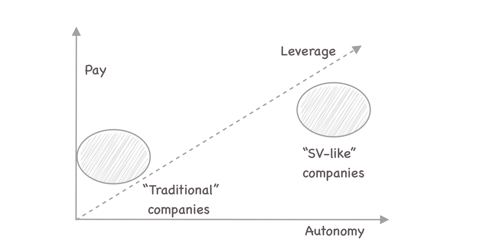
What Silicon Valley "Gets" about Software Engineers that Traditional Companies Do Not blog.pragmaticengineer.com
“1. Autonomy for software engineers; 2. Curious problem solvers, not mindless resources; 3. Internal data, code, and documentation transparency; 4. Exposure to the business and to business metrics; 5. Engineer-to-engineer comms over triangle-communication; 6. Investing in a…
-
Surprising Things About Working at Well-Known Tech Unicorns blog.pragmaticengineer.com
Echoes my own experience on differences between expectations and reality in high growth and visible companies from the point of view of an engineering manager.
-
Developers mentoring other developers: practices I've seen work well blog.pragmaticengineer.com
Discusses mentorship practices that work well engineer-to-engineer.
-
Programmer Interrupted blog.ninlabs.com
Research shows the devastating effect of interrupting developers: 1. 15 min is required to resume work; 2. A programmer get just one uninterrupted 2-hour session in a day; 3. Worst time to interrupt: during edits, searches & comprehension.
-
Teams are like bread blog.jessitron.com
Resonates with the Absorb and Split strategy discussed above: “if you have one team where the magic is flourishing, don't kill it. Feed it, grow it, and let it be a source of further strong teams. No rushing.”
-
Ten simple rules for structuring papers biorxiv.org
“Focusing on how readers consume information, we present a set of 10 simple rules to help you get across the main idea of your paper.”
-
Wadge's Law (of Meetings) billwadge.wordpress.com
“Before every formal meeting there's a smaller, more exclusive, less formal meeting where all the important decisions are made.”
-
10 Admirable Attributes of a Great Technical Lead betterprogramming.pub
“They are smart yet kind. Knowledgeable, yet humble. Busy, yet approachable.”
-
The Art of Powerful Questions - Catalyzing Insight, Innovation, and Action betterevaluation.org
“Leaders believe that they are being paid for fixing problems rather than for fostering breakthrough thinking.”
-
Strategies for long Projects benbrostoff.github.io
Relentless, irrational optimism; Daily progress documentation; Compounding investments; Time budgeting.
-
The Surprising Traits of Good Remote Leaders bbc.com
“the confidence, intelligence and extroversion that have long propelled ambitious workers into the executive suite are not enough online because they simply don't translate into virtual leadership. (…) Instead, workers who are organized, dependable and productive take the reins…
-
Why procrastination is about managing emotions, not time bbc.com
“Research shows that once the first step is made towards a task, following through becomes easier”.
-
The six ways to influence people bakadesuyo.com
6 universal principles of influence that are used to persuade business professionals: reciprocity, consistency, social proof, getting people to like you, authority and scarcity.
-
-
What Happens When Your Career Becomes Your Whole Identity archive.ph
“A particular confluence of high achievement, intense competitiveness, and culture of overwork has caught many in a perfect storm of career enmeshment and burnout.”
-
The SaaS Org Chart archive.ph
Blueprints of an organization at each stage of its 50/125/400/1000-employees stages, with typical ratios and ARR.
-
Things Many People Find Too Obvious To Have Told You Already archive.ph
A set of heuristics on tech companies and the ecosystem they live in.
-
Why do some developers at Google consider Agile development to be nonsense? archive.ph
Because the short-term focused Scrum processes “seem suited to particular types of development, most notably consulting or contract programming, where the customer is external to the organizations, runs the show because they are paying for development, and can change their mind…
-
How to get promoted archive.ph
The cynical take: “an opportunist's career advice is: ignore OKRs, switch projects well before the consequences of your decisions can be measured, act happy and easy-going, package bad news as appeals for slow systemic adjustments, don't make anyone look bad, perform rituals…
-
The failure of Scaling Etsy archive.ph
When a company lacks technical leadership: developers waste time in costly refactors, over-engineered systems, and ends up detached from the business and product.
-
OKRs from a development team's perspective archive.ph
On how OKRs articulates with a backlog.
-
How CEOs Manage Time archive.ph
A study on what CEO of large companies spent their time on, and how. Opens a new window into what leadership is all about and into its many components and dimensions.
-
It's Not Enough to Be Right—You Also Have to Be Kind archive.ph
“It's harder to be kind than clever”, or put another way by Abraham Joshua Heschel: “When I was young, I used to admire intelligent people; as I grow older, I admire kind people.”
-
Why I Rejected My Manager archive.ph
“I understand now why the saying is: people leave managers, not companies.”
-
If Your Boss Could Do Your Job, You're More Likely to Be Happy at Work archive.ph
“Although we found that many factors can matter for happiness at work – type of occupation, level of education, tenure, and industry are also significant, for instance – they don't even come close to mattering as much as the boss' technical competence.”
-
How the biggest consumer apps got their first 1,000 users archive.ph
How the biggest apps out there started: from going to your user directly (both online and offline), creating FOMO and word-of-mouth, to build a community first and get press.
-
What Only the CEO Can Do archive.ph
“1. Defining and interpreting the meaningful "outside" of the company; 2. Answering the two-part question: What business are we in and what business are we not in? 3. Balancing sufficient yield in the present with necessary investment in the future; 4. Shaping the values and…
-
Good business mafias form archive.ph
when there's a group of people who all have to quit their job for reasons that are exogenous to their performance. In the case of Paypal, it was an acquisition; at Tiger Management, a few years of underperformance; at Drexel Burnham Lambert, an indictment. In Reliance's case…
-
Who are you trying to impress with your deadlines? archive.ph
“There are companies where those deadlines are set in stone, and a missed deadline is next to fire. That's when the problem starts.”
-
Operations and Internal Communication Strategies For Effective CEOs archive.ph
After insisting on the importance of context and narratives, the author provide an interesting template (good for inspiration) of ritual and recurring internal communication devices.
-
If You're So Successful, Why Are You Still Working 70 Hours a Week? archive.ph
“Our tendency to overwork and burn out is framed by a complex combination of factors involving our profession, our organization, and ourselves. At the heart of it is insecurity.”
- next page of items loading…