How explanation guides belief change
Trends in Cognitive Sciences, 2021. [All Versions]. Philosophers have argued that people ought to change their graded beliefs via Bayes’ rule. Recent work in psychology indicates that people sometimes violate that rule by attending to explanatory factors. Results from…
- from
- AGI & CoCoSci
- added
- 2026-10-10
- likes
- 0
similar
-
The Role of Explanatory Considerations in Updating sciencedirect.com
Cognition, 2015. [All Versions]. This paper investigates experimentally controversy in philosophy about the connection between explanation and inference, of whether judgments of the explanatory goodness of hypotheses do play a role when people revise their degrees of belief in…
-
Explanatory Preferences Shape Learning and Inference scholar.princeton.edu
Trends in Cognitive Sciences, 2016. [All Versions]. People often learn by seeking explanations, and they assess the viability of hypotheses by considering how well they explain the data. An emerging body of work reveals that both children and adults have strong and systematic…
-
Explanation, updating, and accuracy tandfonline.com
Journal of Cognitive Psychology, 2016. [All Versions]. There is evidence that people update their credences partly on the basis of explanatory considerations. Philosophers have recently argued that to minimise the inaccuracy of their credences, people's updates also ought to be…
-
Where do hypotheses come from? sciencedirect.com
Cognitive Psychology, 2017. [All Versions]. [Preprint]. Why are human inferences sometimes remarkably close to the Bayesian ideal and other times systematically biased? In particular, why do humans make near-rational inferences in some natural domains where the candidate…
-
The structure and function of explanations cognition.princeton.edu
Trends in Cognitive Sciences, 2006. [All Versions]. Generating and evaluating explanations is spontaneous, ubiquitous and fundamental to our sense of understanding. Recent evidence suggests that in the course of an individual's reasoning, engaging in explanation can have…
-
How do people generalize causal relations over objects? A non-parametric Bayesian account link.springer.com
Computational Brain & Behavior, 2022. [All Versions]. [Preprint]. How do people decide how general a causal relationship is, in terms of the entities or situations it applies to? What features do people use to decide whether a new situation is governed by a new causal law or an…
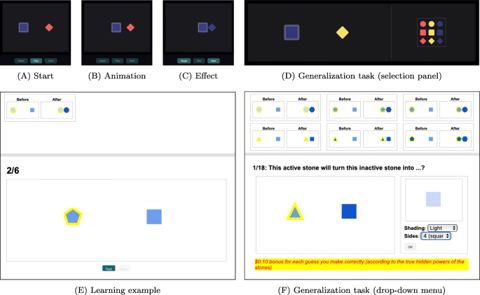
AGI & CoCoSci › Papers > Abduction > Explanation: “Trends in Cognitive Sciences, 2021. [All Versions]. Philosophers have argued that people ought to change their graded beliefs via Bayes’ rule. Recent work in psychology indicates that people sometimes violate that rule by attending to explanatory factors. Results from…”