How do people generalize causal relations over objects? A non-parametric Bayesian account
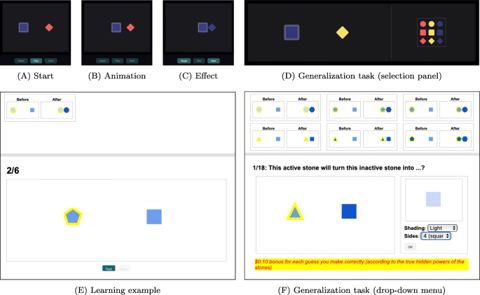
Computational Brain & Behavior, 2022. [All Versions]. [Preprint]. How do people decide how general a causal relationship is, in terms of the entities or situations it applies to? What features do people use to decide whether a new situation is governed by a new causal law or an…
- from
- AGI & CoCoSci
- added
- 2026-10-10
- likes
- 0
similar
-
Generalization, similarity, and Bayesian inference cambridge.org
Behavioral and Brain Sciences, 2001. [All Versions]. [Preprint]. Shepard has argued that a universal law should govern generalization across different domains of perception and cognition, as well as across organisms from different species or even different planets. Starting…
-
Theory-Based Causal Induction cocosci.princeton.edu
Psychological Review, 2009. [All Versions]. Thomas Griffiths' review on causal Bayesian theory induction.
-
Theory-based Bayesian models of inductive learning and reasoning cell.com
Trends in Cognitive Sciences, 2006. [All Versions]. [Preprint]. Inductive inference allows humans to make powerful generalizations from sparse data when learning about word meanings, unobserved properties, causal relationships, and many other aspects of the world. Traditional…
-
Use of current explanations in multicausal abductive reasoning onlinelibrary.wiley.com
Cognitive Science, 2001. [All Versions].
-
Where do hypotheses come from? sciencedirect.com
Cognitive Psychology, 2017. [All Versions]. [Preprint]. Why are human inferences sometimes remarkably close to the Bayesian ideal and other times systematically biased? In particular, why do humans make near-rational inferences in some natural domains where the candidate…
-
Constraints on Hypothesis Selection in Causal Learning cogsci.mindmodeling.org
CogSci'15, 2015. [All Versions].
AGI & CoCoSci › Papers > Causality: “Computational Brain & Behavior, 2022. [All Versions]. [Preprint]. How do people decide how general a causal relationship is, in terms of the entities or situations it applies to? What features do people use to decide whether a new situation is governed by a new causal law or an…”