Towards end-to-end automation of AI research
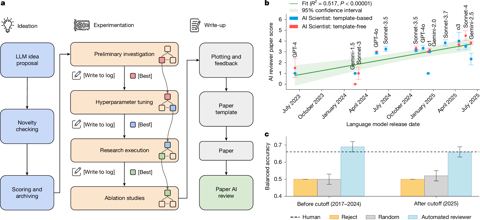
Nature, 2026. [All Versions]. The automation of science is a long-standing ambition in artificial intelligence (AI) research. Although the community has made substantial progress in automating individual components of the scientific process, a system that autonomously navigates…
- from
- AGI & CoCoSci
- added
- 2026-10-10
- likes
- 0
similar
-
Automation isn't automatic pubs.rsc.org
Chemical Science, 2021. [All Versions]. This perspective provides an overview of the current state of automation of synthetic chemistry at the benchtop scale with a particular emphasis on core considerations and the ensuing challenges of deploying a system. The authors aim to…
-
Balancing autonomy and expertise in autonomous synthesis laboratories nature.com
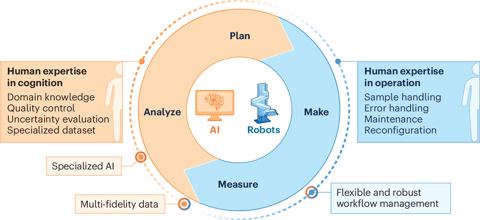
Nature Computational Science, 2025. [All Versions]. Autonomous synthesis laboratories promise to streamline the plan–make–measure–analyze iteration loop. Here, the authors comment on the barriers in the field, the promise of a human on-the-loop approach, and strategies for…
-
Autonomous chemical research with large language models nature.com
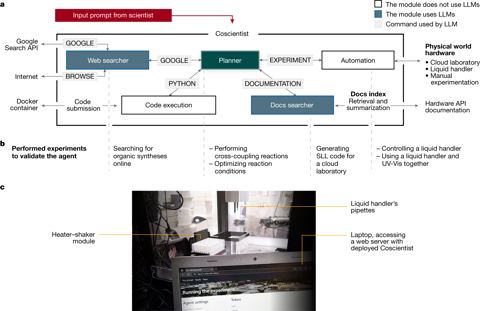
Nature, 2023. [All Versions]. An artificial intelligence system driven by GPT-4 that autonomously designs, plans and performs complex experiments by incorporating large language models empowered by tools such as internet and documentation search, code execution and experimental…
-
Scientific discovery in the age of artificial intelligence nature.com
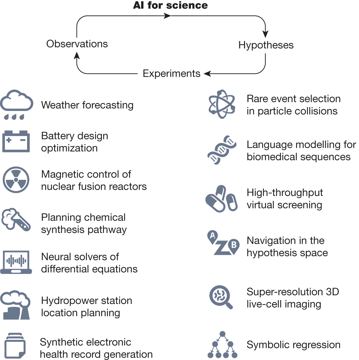
Nature, 2023. [All Versions]. A review article that examines breakthroughs over the past decade that include self-supervised learning, which allows models to be trained on vast amounts of unlabelled data, and geometric deep learning, which leverages knowledge about the…
-
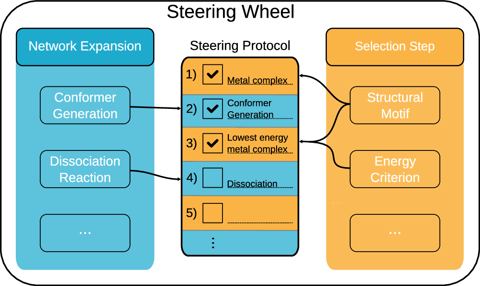
A human-machine interface for automatic exploration of chemical reaction networks nature.com
Nature Communications, 2024. [All Versions]. Autonomous reaction network exploration algorithms offer a systematic approach to explore mechanisms of complex chemical processes. However, the resulting reaction networks are so vast that an exploration of all potentially…
-
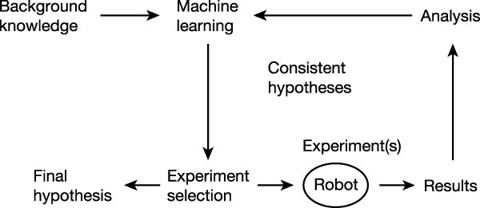
Functional genomic hypothesis generation and experimentation by a robot scientist nature.com
Nature, 2004. [All Versions]. This paper describes a physically implemented robotic system that applies techniques from artificial intelligence to carry out cycles of scientific experimentation. The system automatically originates hypotheses to explain observations, devises…
AGI & CoCoSci › Papers > Science Logology > AI Assisted Research: “Nature, 2026. [All Versions]. The automation of science is a long-standing ambition in artificial intelligence (AI) research. Although the community has made substantial progress in automating individual components of the scientific process, a system that autonomously navigates…”