Foundations of intuitive power analyses in children and adults
Nature Human Behavior, 2022. [All Versions]. Evidences support that people have some of the foundations for 'intuitive power analyses', which help people use intuitive statistical reasoning and metacognitive strategies to estimate how much information they might need to solve…
- from
- AGI & CoCoSci
- added
- 2026-10-10
- likes
- 0
similar
-
Functional neuroanatomy of intuitive physical inference pnas.org
Proceedings of the National Academy of Sciences, 2016. [All Versions]. A piece of evidence for the functional part of intuitive physics in human brain.
-
Children and adults as intuitive scientists psycnet.apa.org
Psychological Review, 1989. [All Versions]. A perspective against search as scientific thinking.
-
Limits on Simulation Approaches in Intuitive Physics sciencedirect.com
Cognitive Psychology, 2021. [All Versions]. Ernest Davis's perspective against intuitive physics, that physcial reasoning is logical reasoning instead of intuition.
-
The cognitive bases of human tool use eva.mpg.de
Behavioral and Brain Sciences, 2012. [All Versions].
-
The naïve utility calculus: Computational principles underlying commonsense psychology cell.com
Trends in Cognitive Sciences, 2016. [All Versions]. [Preprint]. This review article proposes that human social cognition is structured around a basic understanding of ourselves and others as intuitive utility maximizers: from a young age, humans implicitly assume that agents…
-
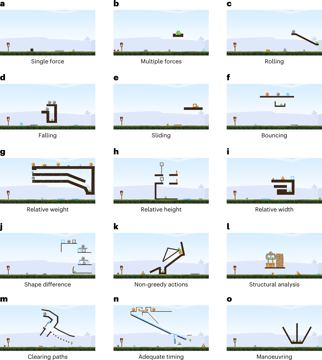
Phy-Q as a measure for physical reasoning intelligence nature.com
Nature Machine Intelligence, 2023. [NMI Challenge]. An interactive benchmark for AI physical reasoning.
AGI & CoCoSci › Papers > Meta-Level Considerations > Rationality: “Nature Human Behavior, 2022. [All Versions]. Evidences support that people have some of the foundations for 'intuitive power analyses', which help people use intuitive statistical reasoning and metacognitive strategies to estimate how much information they might need to solve…”