The naïve utility calculus: Computational principles underlying commonsense psychology
Trends in Cognitive Sciences, 2016. [All Versions]. [Preprint]. This review article proposes that human social cognition is structured around a basic understanding of ourselves and others as intuitive utility maximizers: from a young age, humans implicitly assume that agents…
- from
- AGI & CoCoSci
- added
- 2026-10-10
- likes
- 0
similar
-
The Naïve Utility Calculus as a unified, quantitative framework for action understanding sciencedirect.com
Cognitive Psychology, 2021. [All Versions]. [Project]. This paper presents a formal theory of the Naïve Utility Calculus as a probabilistic generative model, which highlights the role of cost and reward tradeoffs in a Bayesian framework for action-understanding. The model…
-
Computational Rationality: Linking Mechanism and Behavior Through Bounded Utility Maximization onlinelibrary.wiley.com
Topics in Cognitive Science, 2014. [All Versions]. Introducing the computational rationality framework for including information-processing bounds in rational analyses, which emphasizes the incorporation of computational mechanism into the definition of rational action.
-
Tool use and affordance: Manipulation-based versus reasoning-based approaches psycnet.apa.org
Psychological Review, 2016. [All Versions]. A classic review on human tool use and affordance.
-
Goals, usefulness and abstraction in value-based choice sciencedirect.com
Trends in Cognitive Sciences, 2023. [All Versions]. A review that outlines the computational and biological principles that enable the brain to compute the usefulness of an option or action by creating abstractions that flexibly adapt to changing goals.
-
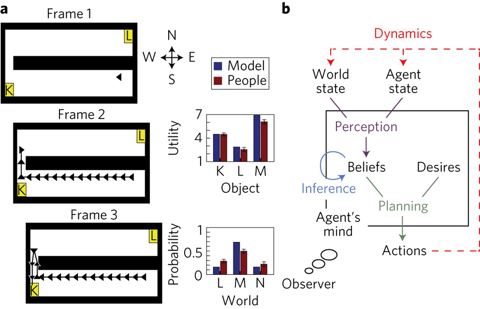
Rational quantitative attribution of beliefs, desires and percepts in human mentalizing nature.com
Nature Human Behavior, 2017. [All Versions]. [Preprint]. This paper presents a model of core mentalizing computations: inferring jointly an actor’s beliefs, desires and percepts from how they move in the local spatial environment. The proposed Bayesian theory of mind (BToM)…
-
Basic functional trade-offs in cognition: An integrative framework sciencedirect.com
Cognition, 2018. [All Versions].
AGI & CoCoSci › Papers > Theory of Mind: “Trends in Cognitive Sciences, 2016. [All Versions]. [Preprint]. This review article proposes that human social cognition is structured around a basic understanding of ourselves and others as intuitive utility maximizers: from a young age, humans implicitly assume that agents…”