DOS
136 items from balintkissdev/awesome-dos ★640
-
DJGPP VESA guide delorie.com
Tutorial about querying VESA modes.
-
DJGPP delorie.com
DJ Delorie's complete 32-bit C/C++ development environment for Intel 80386. Used for Quake.
-
PythonD caddit.net
Python for DOS, including multi-threading, networking and OpenGL.
-
Insight bttr-software.de
Very small debugger for real-mode DOS programs with Borland's Turbo like UI. Features an i80486 disassembler, and i8086 assembler.
-
640k Really is Enough for Anyone by Robert W. Oliver II blog.sourcerer.io
Short article about getting Turbo C running on FreeDOS and moving a pixel around.
-
The Life of MS-DOS by Brendan Byers b13rg.github.io
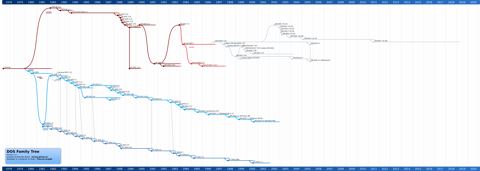
History of the DOS family including CP/M, Q-DOS/86-DOS, MS-DOS and PC-DOS. Article also includes a diagram of the timeline and family tree of DOS operating systems.
-
Turbo C++ 3.0 archive.org
C++ IDE and compiler from Borland released in 1992.
-
Lua for DOS archive.org
Online demo of Lua 5.3.5, compiled for MS-DOS on the Intel 80486 processor.
-
DIV Games Studio 2 archive.org
IDE to develop DOS games in 2d, mode 7 and 3d. Released in 1998.
-
Magenta's Maze archive.org
3D maze game using CGA graphics with algebra as theme.
-
Tricks of the Game-Programming Gurus - by Andre Lamothe, John Ratcliff and Denise Tyler amazon.com
Comprehensive DOS game development book about starting out. Topics include keyboard, mouse- and joystick input handling, creating 2D and 3D VGA graphics, raycaster rendering, sound and music, game algorithms, Interrupt Service Routines (ISR), timers, artificial intelligence…
-
More Tricks of the Game Programming Gurus - by Greg Anderson amazon.com
Companion book to Tricks of the Game Programming Gurus, continuing where the original left off. Topics include SVGA, Binary Space Partition (BSP), UI, voxel graphics, memory management in real and protected mode, advanced sound programming, debugging and optimization techniques.
-
80x86 16-bit Compiling How-to by Alexei A. Frounze alexfru.narod.ru
16-bit compilation tutorial for Borland/Turbo C/C++ and Open Watcom. Goes into depth of memory addressing and memory models.