-
START kcvi.shinyapps.io
Shiny Transcriptome Analysis Resource Tool allows users to visualize RNA-seq data starting with count data.
-
Brain mRNA Isoform Atlas isoformatlas.com
Visualize cell type signatures of alternative splicing in postnatal development.
-
IONpath MIBItracker ionpath.com
Slide and image data.
-
Snake Oil Supplements informationisbeautiful.net
Scientific evidence for popular health supplements.
-
IMP: Integrative Multi-species Prediction imp.princeton.edu
Analyze your experimental results in the functional context of gene-gene networks from multiple organisms.
-
HiPiler hipiler.higlass.io
A tool for visually exploring and aggregating reoccurring patterns (like loops, TADs, etc.) in Hi-C maps.
-
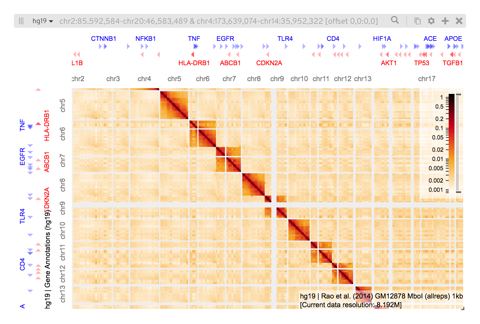
HiGlass higlass.io
A tool for exploring genomic contact matrices and tracks.
-
neuroglancer hemibrain-dot-neuroglancer-demo.appspot.com
Tool for visualization of highly detailed maps of neuronal connectivity in the fly brain.
-
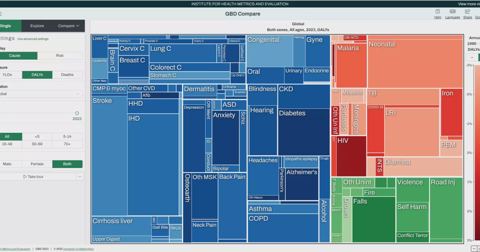
Institute for Health Metrics and Evaluation healthdata.org
Visualizations of disease worldwide.
-
Gosling gosling.js.org
A grammar-based toolkit for scalable and interactive genomics data visualization.
-
GeneMANIA genemania.org
Helps predict the function of genes and gene sets.
-
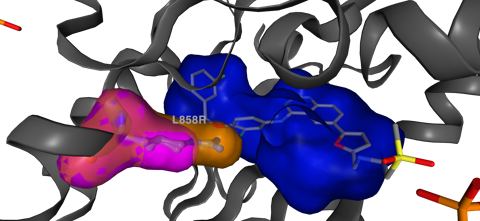
Genomics 2 Proteins portal g2p.broadinstitute.org
A platform for connecting genomic data to protein sequence and protein structure.
-
FlyWire flywire.ai
A human-AI collaboration to map the fly connectome.
-
gbatlas fishka.bio
Interactive viewer for GenBank/GenPept records: linear and circular feature maps, CDS translation, ORF and restriction-site layers, entirely in the browser.
-
iCoMut Beta for FireBrowse firebrowse.org
Interactive exploration of mutation rates, mutation signatures, clinical data, gene mutations.
-
ExploSig explosig.lrgr.io
Interactive visualization of mutational signatures and clinical data.
-
Epiviz epiviz.cbcb.umd.edu
Interactive visual analytics for functional genomics data.
-
WashU Epigenome Browser epigenomegateway.wustl.edu
Displays many sequencing-based data sets across all or part of the genome, on specific gene sets or pathways, and in the context of their metadata.
-
Race, Gender, and Age in TCGA enpicom.com
An interactive visualization of patient gender, race, and age in The Cancer Genome Atlas (TCGA) dataset.
-
Mutaframe deogen2.mutaframe.com
Visualize variants of the human genome.
-
Delta delta.big.ac.cn
An integrative analysis and visualization platform for 3D genome.
-
Cytosplore cytosplore.org
Cytosplore is an interactive visual analysis system for the analysis of mass cytometry data.
-
Lifespans cotrino.com
Visualization of the lifespans of multiple species.
-
Allen Mouse Brain Connectivity Atlas connectivity.brain-map.org
A high-resolution map of neural connections in the mouse brain.
-
Coessentiality coessentiality.net
A genome-wide almanac of co-essential modules assigns function to uncharacterized genes.
-
Allen Brain Map - Transcriptomics Explorer celltypes.brain-map.org
Atlas of human and mouse transcriptomic cell types.
-
UCSC Cell Browser cells.ucsc.edu
An interactive viewer for single-cell expression.
-
PLACNETw castillo.dicom.unican.es
A graph-based tool for reconstruction of plasmids from next generation sequence pair-end datasets.
-
COSMIC-3D cancer.sanger.ac.uk
A platform for understanding cancer mutations in the context of 3D protein structure.
-
COSMIC Cancer Browser cancer.sanger.ac.uk
Browse COSMIC data by tissue type and histology.
-
Avivator avivator.gehlenborglab.org
A lightweight "batteries-included" WebGL viewer for remote imaging data in Bio-Formats Zarr or OME-TIFF format.
-
ASAP asap.epfl.ch
A collaborative portal to analyze single-cell transcriptomics data.
-
L1000FWD amp.pharm.mssm.edu
Large-scale visualization of drug-induced transcriptomic signatures.
-
AlzMap alzmap.org
Spatial transcriptomics in Alzheimer's disease.
-
Juicebox aidenlab.org
Visualization for Hi-C data.
-
Network based credit risk models tandfonline.com
Peer-to-Peer lending platforms may lead to cost reduction, and to an improved user experience. These improvements may come at the price of inaccurate credit risk measurements. The authors propose to augment traditional credit scoring methods with “alternative data” that consist…
-
'Lending by numbers': credit scoring and the constitution of risk within American consumer credit tandfonline.com
Examines how statistical credit-scoring technologies became applied by lenders to the problem of controlling levels of default within American consumer credit. Explores their perceived methodological, procedural and temporal risks.
-
Good practice in retail credit scorecard assessment tandfonline.com
In retail banking, predictive statistical models called ‘scorecards’ are used to assign customers to classes, and hence to appropriate actions or interventions. Such assignments are made on the basis of whether a customer's predicted score is above or below a given threshold…
-
Machine Learning in Credit Risk Modeling slideshare.net
James (formerly CrowdProcess) is a now-defunct online credit risk management startup that provided risk management tools to financial institutions. This whitepaper offers an overview of machine learning applications in the field of credit risk modeling.
-
Credit scoring methods: Latest trends and points to consider sciencedirect.com
"(...) This article aims at providing a systemic review of the most recent (2016–2021) articles, identifying trends in credit scoring using a fixed set of questions. The survey methodology and questionnaire align with previous similar research that analyses articles on credit…
-
Regulatory learning: How to supervise machine learning models? An application to credit scoring sciencedirect.com
The arrival of Big Data strategies is threatening the latest trends in financial regulation related to the simplification of models and the enhancement of the comparability of approaches chosen by financial institutions. Indeed, the intrinsic dynamic philosophy of Big Data…
-
A multi-objective approach for profit-driven feature selection in credit scoring sciencedirect.com
In credit scoring, feature selection aims at removing irrelevant data to improve the performance and interpretability of the scorecard. Standard techniques treat feature selection as a single-objective task and rely on statistical criteria such as correlation. Recent studies…
-
Classification methods applied to credit scoring: Systematic review and overall comparison sciencedirect.com
The need for controlling and effectively managing credit risk has led financial institutions to excel in improving techniques designed for this purpose, resulting in the development of various quantitative models by financial institutions and consulting companies. Hence, the…
-
A comparative study on base classifiers in ensemble methods for credit scoring sciencedirect.com
In the last years, the application of artificial intelligence methods on credit risk assessment has meant an improvement over classic methods. Recent works show that ensembles of classifiers achieve the better results for this kind of tasks.
-
Credit scoring using the clustered support vector machine sciencedirect.com
Introduces the use of the clustered support vector machine (CSVM) for credit scorecard development. This recently designed algorithm addresses some of the limitations associated with traditional nonlinear support vector machine (SVM) based methods for classification…
-
Combination of feature selection approaches with SVM in credit scoring sciencedirect.com
An effective classificatory model in credit scoring will objectively help managers who rely on intuitive experience. This study proposes four approaches using the SVM (support vector machine) classifier for feature selection that retain sufficient information for classification…
-
Multiple classifier application to credit risk assessment sciencedirect.com
(Corrigendum) - This paper explores the predicted behaviour of five classifiers for different types of noise in terms of credit risk prediction accuracy, and how such accuracy could be improved by using classifier ensembles.
-
The comparisons of data mining techniques for the predictive accuracy of probability of default of credit card clients sciencedirect.com
This research compares the predictive accuracy of probability of default among six data mining methods. From the perspective of risk management, the result of predictive accuracy of the estimated probability of default will be more valuable than the binary result of…
-
Benchmarking state-of-the-art classification algorithms for credit scoring: An update of research sciencedirect.com
There have been several advancements in scorecard development, including novel learning methods, performance measures and techniques to reliably compare different classifiers, which the credit scoring literature does not reflect. This paper compares several novel classification…
-
Reject inference, augmentation, and sample selection sciencedirect.com
In-depth discussion.
- next page of items loading…