Reject inference, augmentation, and sample selection
In-depth discussion.
- from
- Credit Modeling
- added
- 2026-10-10
- likes
- 0
similar
-
Reject inference in application scorecards: evidence from France econpapers.repec.org
Good introduction and discussion on the topic.
-
Instance sampling in credit scoring: An empirical study of sample size and balancing research.lancs.ac.uk
Discusses the traditional sampling conventions in credit modeling and argues that using larger samples provides a significant increase in accuracy across algorithms.
-
Parameter Expansion for Data Augmentation tandfonline.com
Journal of the American Statistical Association, 1999. [All Versions]. [Preprint]. Viewing the observed data of a statistical model as incomplete and augmenting its missing parts are useful for clarifying concepts and central to the invention of two well-known statistical…
-
Theory-based Bayesian models of inductive learning and reasoning cell.com
Trends in Cognitive Sciences, 2006. [All Versions]. [Preprint]. Inductive inference allows humans to make powerful generalizations from sparse data when learning about word meanings, unobserved properties, causal relationships, and many other aspects of the world. Traditional…
-
Regulatory learning: How to supervise machine learning models? An application to credit scoring sciencedirect.com
The arrival of Big Data strategies is threatening the latest trends in financial regulation related to the simplification of models and the enhancement of the comparability of approaches chosen by financial institutions. Indeed, the intrinsic dynamic philosophy of Big Data…
-
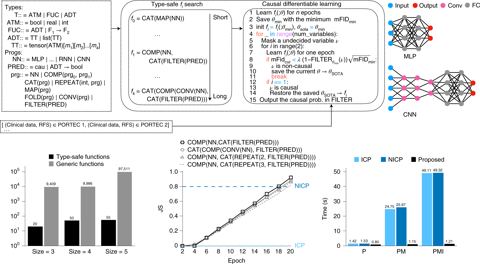
Automated causal inference in application to randomized controlled clinical trials nature.com
Nature Machine Intelligence, 2022. [All Versions]. Randomized controlled trials (RCTs) are considered the gold standard for testing causal hypotheses in the clinical domain; however, the investigation of prognostic variables of patient outcome in a hypothesized cause–effect…
Credit Modeling › Sample Selection: “In-depth discussion.”