Programming
Software development: programming languages, coding, libraries and frameworks, software engineering and architecture, source control, developer tools, databases, and infrastructure.
-
Domain-specific languages: an annotated bibliography dl.acm.org
ACM SIGPLAN Notices, 2000. [All Versions]. A survey on the topic of domain-specific languages as used for the construction and maintenance of software systems. The survey lists a selection of 75 key publications in the area, and provides a summary for each of the papers…
-
PLIERS: A Process that Integrates User-Centered Methods into Programming Language Design dl.acm.org
ACM Transactions on Computer-Human Interaction, 2021. [All Versions]. Programming language design requires making many usability-related design decisions. However, existing HCI methods can be impractical to apply to programming languages: languages have high iteration costs…
-
Synthesis of Incremental Linear Algebra Programs dl.acm.org
ACM Transactions on Database Systems, 2020. [All Versions]. This article targets the Incremental View Maintenance (IVM) of sophisticated analytics (such as statistical models, machine learning programs, and graph algorithms) expressed as linear algebra programs. This work…
-
A Taxonomy of Domain-Specific Aspect Languages dl.acm.org
ACM Computing Surveys, 2015. [All Versions]. Domain-Specific Aspect Languages (DSALs) are Domain-Specific Languages (DSLs) designed to express crosscutting concerns. Compared to DSLs, their aspectual nature greatly amplifies the language design space. This survey structures…
-
When and How to Develop Domain-Specific Languages dl.acm.org
ACM Computing Surveys, 2005. [All Versions]. [Preprint]. Domain-specific languages (DSLs) are languages tailored to a specific application domain. They offer substantial gains in expressiveness and ease of use compared with general-purpose programming languages in their domain…
-
Exploring human cognition using large image databases cocosci.princeton.edu
Topics in Cognitive Sciences, 2016. [All Versions].
-
A high-level programming language for generative protein design biorxiv.org
2022. [All Versions]. Combining a basic set of building blocks into more complex forms is a universal design principle. Most protein designs have proceeded from a manual bottom-up approach using parts created by nature, but top-down design of proteins is fundamentally hard due…
-
Intentonomy: a Dataset and Study towards Human Intent Understanding arxiv.org
CVPR'21, 2021. [All Versions]. A large-scale database on human intentionally-posted images on social media.
-
Human Comprehensible Active Learning of Genome-Scale Metabolic Networks arxiv.org
AAAI Spring Symposium Series 2023 on Computational Scientific Discovery, 2023. [All Versions]. [Extended Abstract]. [Slides]. This work introduces a novel machine learning framework ILP-iML1515 based on Inductive Logic Programming (ILP) that performs abductive logical reasoning…
-
Large Language Models for Software Engineering: A Systematic Literature Review arxiv.org
2023. [All Versions]. A systematic literature review on LLM4SE, with a particular focus on understanding how LLMs can be exploited to optimize processes and outcomes.
-
2023. [All Versions]. [Project]. [Website]. This paper proposes CLAIRIFY, an approach that combines automatic iterative prompting with program verification to ensure programs written in data-scarce domain-specific language are syntactically valid and incorporate environment…
-
Program Synthesis with Large Language Models arxiv.org
2021. [All Versions]. This paper explores the limits of the current generation of large language models for program synthesis in general purpose programming languages.
-
Inductive logic programming at 30: a new introduction arxiv.org
Journal of Artificial Intelligence Research, 2020. [All Versions]. A 30-year comprehensive review on Inductive Logic Programming.
-
DeepProbLog: Neural Probabilistic Logic Programming arxiv.org
NeurIPS'18, 2018. [All Versions]. The original paper on neuro-symbolic probabilistic programming.
-
Design Guidelines for Domain Specific Languages arxiv.org
OOPSLA Workshop on Domain-Specific Modeling (DSM' 09), 2009. [All Versions]. Designing a new domain specific language is as any other complex task sometimes error-prone and usually time consuming, especially if the language shall be of high-quality and comfortably usable…
-
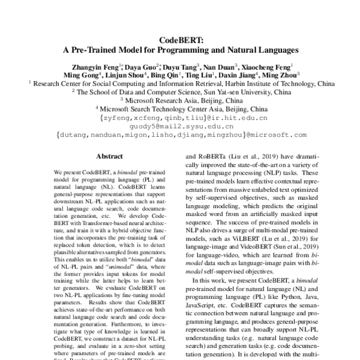
CodeBERT: A Pre-Trained Model for Programming and Natural Languages aclanthology.org
EMNLP'20, 2020. [All Versions]. Completing code, generating programming documentation, and providing technical support, making programming knowledge more accessible to non-experts.
-
Abductive Logic Programming academic.oup.com
Journal of Logic Computation, 1992. [All Versions]. This paper is a survey and critical overview of recent work on the extension of logic programming to perform abductive reasoning (abductive logic programming). The authors outline the general framework of abduction and its…
-
Theory of Minds: Understanding Behavior in Groups through Inverse Planning aaai.org
AAAI'19, 2019. [All Versions]. Towards the goal of building machine-learning algorithms with human-like social intelligence, this paper develops a generative model of multiagent action understanding based on a novel representation for these latent relationships called…
-
Stealing Machine Learning Models via Prediction APIs usenix.org
(Usenix Security) (Code) Aims at extracting machine learning models in use by remote services.
-
Black-Box Ripper: Copying black-box models using generative evolutionary algorithms proceedings.neurips.cc
(NeurIPS) Replicates the functionality of a black-box neural model, yet with no limit on the amount of queries (via a teacher/student scheme and an evolutionary search).
-
Active Fairness Auditing proceedings.mlr.press
(ICML) Studies of query-based auditing algorithms that can estimate the demographic parity of ML models in a query-efficient manner.
-
Bayesian Algorithm Execution: Estimating Computable Properties of Black-box Functions Using Mutual Information proceedings.mlr.press
(ICML) A budget constrained and Bayesian optimization procedure to extract properties out of a black-box algorithm.
-
Stealing the Decoding Algorithms of Language Models people.cs.umass.edu
(CCS) Steal the type and hyperparameters of the decoding algorithms of a LLM.
-
Opening Up the Black Box:Auditing Google's Top Stories Algorithm par.nsf.gov
(Flairs-32) Audit of the Google's Top stories panel that pro-vides insights into its algorithmic choices for selectingand ranking news publisher
-
Confidential-PROFITT: Confidential PROof of FaIr Training of Trees openreview.net
(ICLR) Proposes fair decision tree learning algorithms along with zero-knowledge proof protocols to obtain a proof of fairness on the audited server.
-
Two-Face: Adversarial Audit of Commercial Face Recognition Systems ojs.aaai.org
(ICWSM) Performs an adversarial audit on multiple systems APIs and datasets, making a number of concerning observations.
-
Scaling up search engine audits: Practical insights for algorithm auditing journals.sagepub.com
(Journal of Information Science) (Code) Audits multiple search engines using simulated browsing behavior with virtual agents.
-
The Imitation Game: Algorithm Selectionby Exploiting Black-Box Recommender github.com
(Netys) (Code) Parametrize a local recommendation algorithm by imitating the decision of a remote and better trained one.
-
Auditing Algorithms: On Lessons Learned and the Risks of DataMinimization dl.acm.org
(AIES) A practical audit for a well-being recommendation app developed by Telefónica (mostly on bias).
-
Auditing YouTube’s Recommendation Algorithm for Misinformation Filter Bubbles dl.acm.org
(Transactions on Recommender Systems) What it takes to “burst the bubble,” i.e., revert the bubble enclosure from recommendations.
-
Peeking Beneath the Hood of Uber dl.acm.org
(IMC) Infer implementation details of Uber's surge price algorithm.
-
Bias in Online Freelance Marketplaces: Evidence from TaskRabbit datworkshop.org
(dat workshop) Measures the TaskRabbit's search algorithm rank.
-
The Fair Game: Auditing & debiasing AI algorithms overtime cambridge.org
(Cambridge Forum on AI: Law and Governance) Aims to simulate the evolution of ethical and legal frameworks in the society by creating an auditor which sends feedback to a debiasing algorithm deployed around an ML system.
-
The Fair Game: Auditing & debiasing AI algorithms over time cambridge.org
Jouarnal of Cambridge Forum on AI: Law and Governance
-
Hardware and software platform inference arxiv.org
(arXiv) A method for identifying the underlying GPU architecture and software stack of a black-box machine learning model solely based on its input-output behavior.
-
(Arxiv) Systematic review of algorithm auditing studies and identification of trends in their methodological approaches.
-
Your Echos are Heard: Tracking, Profiling, and Ad Targeting in the Amazon Smart Speaker Ecosystem arxiv.org
(arxiv) Infers a link between the Amazon Echo system and the ad targeting algorithm.
-
(CHI) Makes the case for "everyday algorithmic auditing" by users.
-
P2NIA: Privacy-Preserving Non-Iterative Auditing arxiv.org
(ECAI) Proposes a mutually beneficial collaboration for both the auditor and the platform: a privacy-preserving and non-iterative audit scheme that enhances fairness assessments using synthetic or local data, avoiding the challenges associated with traditional API-based audits.
-
Setting the Record Straighter on Shadow Banning arxiv.org
(INFOCOM) (Code) Considers the possibility of shadow banning in Twitter (ie, the moderation black-box algorithm), and measures the probability of several hypothesis.
-
TamperNN: Efficient Tampering Detection of Deployed Neural Nets arxiv.org
(ISSRE) Algorithms to craft inputs that can detect the tampering with a remotely executed classifier model.
-
Adversarial Frontier Stitching for Remote Neural Network Watermarking arxiv.org
(Neural Computing and Applications) (Alternative implementation) Check if a remote machine learning model is a "leaked" one: through standard API requests to a remote model, extract (or not) a zero-bit watermark, that was inserted to watermark valuable models (eg, large deep…
-
Downey, A. (2012). Think complexity. Needham, Massachusetts: Green Tea Press. worldcat.org
A hands-on approach exploring complex systems models with Python.
-
Ventity/Vensim ventanasystems.com
Simulation software.
-
Simulus simulus.readthedocs.io
ABM library in Python.
-
Barabási–Albert (BA) model en.wikipedia.org
Algorithm for generating random graphs with preferential attachment.
-
Cosmo Tech platform cosmotech.com
Digital twins simulator software.
-
Recursion Schemes youtube.com
-
-
- next page of items loading…