Math
Mathematics: proofs, geometry, calculus, linear algebra, probability, statistics, and math explained visually.
-
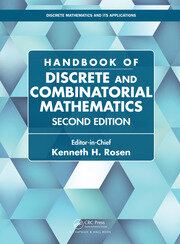
Rosen. Handbook of Discrete and Combinatorial Mathematics taylorfrancis.com
A complete survey of roughly all topics of discrete math and their relevance to computing and communication engineering.
-
Comprehensive Mathematics for Computer Scientists springer.com
A series dedicated to math topics and their relevance to computer science.
-
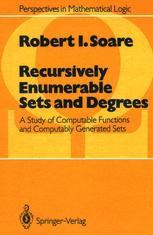
Soare. Recursively Enumerable Sets and Degree springer.com
It gives a complete account of the theory of r.e degrees. The definitions, results and proofs are always clearly motivated and explained before the formal presentation; the proofs are described with remarkable clarity and conciseness.
-
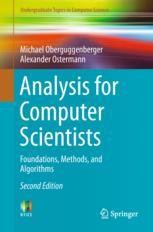
Oberguggenberger & Ostermann. Analysis for Computer Scientists: Foundations, Methods, and Algorithms springer.com
Presents an algorithmic approach to mathematical analysis, with a focus on modelling and on the applications of analysis.
-
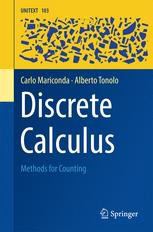
Mariconda & Tonolo. Discrete Calculus: Methods for Counting springer.com
An introduction to combinatorics, finite calculus, formal series, recurrences, and approximations of sums. Readers will find also deep insights into a range of less common topics rarely considered within a single book.
-
Pudlák. Logical Foundations of Mathematics and Computational Complexity: A Gentle Introduction springer.com
Presents a wide range of results in logic and computational complexity.
-
Rosenberg & Trystram. Understand Mathematics, Understand Computing: Discrete Mathematics That All Computing Students… springer.com
It endows the reader with an operational conceptual and methodological understanding of discrete mathematics for computing
-
Makinson. Sets, Logic and Maths for Computing springer.com
It presents a careful selection of the material most needed by students in their first two years studying computer science.
-
Vince. Foundation Mathematics for Computer Science: A Visual Approach springer.com
A range of mathematical topics to provide a solid foundation for an undergraduate course in computer science, starting with a review of number systems and their relevance to digital computers, and finishing with differential and integral calculus.
-
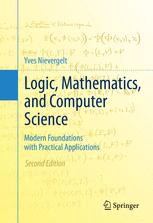
Yves Nievergelt. Logic, Mathematics, and Computer Science: Modern Foundations with Practical Applications springer.com
For lower undergraduates, It introduces the reader to logic, proofs, sets, and number theory, Focusing on foundations. It provides complete details and derivations of formal proofs.
-
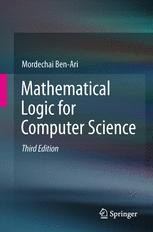
Ben-Ari. Mathematical Logic for Computer Science springer.com
Semantic tableaux are used because they are theoretically sound and easy to understand.
-
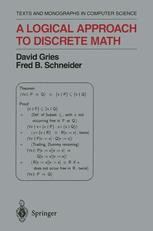
Gries & Schneider. A Logical Approach to Discrete Math springer.com
It attempts to change the way we teach logic to beginning students. Instead of teaching logic as a subject in isolation, we regard it as a basic tool and show how to use it.
-
UW CSE505 18au Principles of PL sites.google.com
Techniques for thinking crisply about programming languages, write some fascinating programs, and discuss various design tradeoffs.
-
Part I scottaaronson.com
& Part II - Part I: Presuppose only linear algebra and a bit of classical algorithms. Topics include quantum circuits, density matrices, entanglement entropy, Wiesner’s quantum money, QKD, quantum teleportation, the Bell inequality, interpretations of QM, the Shor 9-qubit code…
-
Aaronson. Why Should Philosophers Care About Computational Complexity Theory scottaaronson.com
It argues that computational complexity theory leads to new perspectives on the nature of mathematical knowledge and other philosophical questions.
-
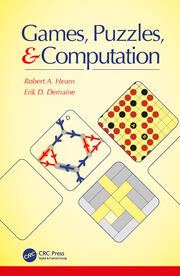
Demaine. Games, Puzzles, and Computation routledge.com
It shows that games and puzzles can serve as powerful models of computation, Offering a new way of thinking about computation.
-
TCS Subreddit reddit.com
Theoretical computer science's subreddit.
-
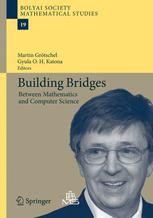
Building Bridges I rd.springer.com
, Building Bridges II, Fete of Combinatorics and Computer Science - Collected works in celebration of Laszlo Lovasz, Connecting discrete math with computer science.
-
Stanford Encyclopedia of Philosophy. Computational Complexity Theory plato.stanford.edu
The foundations of complexity theory, and its potential significance on philosophy of computer science, philosophy of mathematics and epistemology.
-
Jeremy Kun. A Programmer's Introduction to Mathematics pimbook.org
Uses your familiarity with ideas from programming and software to teach mathematics.
-
Papadimitriou. Computational Complexity pearson.com
Body of knowledge for studying the performance and limitations of computer algorithms. Among topics covered are: reductions and NP-completeness, cryptography and protocols, randomized algorithms, and approximability of optimization problems, circuit complexity, the structural…
-
Hopcroft, Motwani & Ullman. Introduction to Automata Theory, Languages, and Computation pearson.com
Introductory undergrad textbook for automata, languages and theory of computation topics.
-
Knuth, Graham & Patashnik. Concrete Mathematics: A Foundation for Computer Science pearson.com
An expansion of the Mathematical Preliminaries section in Knuth's classic Art of Computer Programming, but the style of presentation is more leisurely, and individual topics are covered more deeply.
-
Demaine. Algorithmic Lower Bounds: Fun with Hardness Proofs ocw.mit.edu
A class taking a practical approach to proving problems can't be solved efficient.
-
Demaine, Abel & Chapman. Mathematics for Computer Science ocw.mit.edu
A junior introduction to discrete mathematics for computer scientists. - Companion Textbook 2015
-
Demaine/Devadas/Lynch. Design and Analysis of algorithms. MIT ocw.mit.edu
A second course on algorithms and data structures. — added by Erik himself!
-
Demaine/Ku/Soloman. Introduction to Algorithms. MIT ocw.mit.edu
A first course on basic algorithms and data structures. — added by Erik himself!
-
Kelner. Topics in Theoretical Computer Science: An Algorithmist's Toolkit. MIT ocw.mit.edu
It covers a collection of geometric techniques that apply broadly in modern algorithm design.
-
Yufei. Probabilistic Methods in Combinatorics. MIT ocw.mit.edu
and Yufei's Graph Theory book - Showing some combinatorial object exists and prove that a certain random construction works with positive probability. The course focuses on methodology as well as combinatorial applications.
-
Moore & Mertens. The Nature of Computation nature-of-computation.org
It spans complexity of mazes and games; optimization in theory and practice; randomized algorithms, interactive proofs, and pseudorandomness; Markov chains and phase transitions; and of quantum computing. It provides accessible explanations
-
Telgarsky. Deep Learning Theory. Illinois mjt.cs.illinois.edu
Focuses on simplified proofs over what appears in the literature, and classical perspective of achieving a low test error for binary classification with IID data via standard (typically ReLU) feedforward networks.
-
Rosen. Discrete Mathematics and Its Applications mheducation.com
A canonical discrete math textbook, accessible for even high school students.
-
Paluszynski. Calculus for Computer Scientists math.uni.wroc.pl
calculus lecture notes taught for undergrad computer science students
-
Wigderson. Mathematics and Computation: A Theory Revolutionizing Technology and Science math.ias.edu
A sweeping survey of complexity theory, emphasizing the field’s insights and challenges. It explains the ideas and motivations leading to key models, notions, and results.
-
Eck & Critchlow. Foundations of Computation math.hws.edu
for a one-semester course in theoretical computer science. It has no prerequisites other than introductory computer programming. It includes logic, sets, and function from discrete math, and automata, formal languages, and grammar from upper-level courses.
-
Krantz. Handbook of Logic and Proof Techniques for Computer Science maa.org
A concise offered as an accessible reference on mathematical logic for the professional computer scientist.
-
Useful Inequalities Cheat Sheet lkozma.net
-
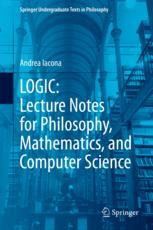
Lacona. LOGIC: Lecture Notes for Philosophy, Mathematics, and Computer Science link.springer.com
Suitable for undergraduate introductions to logic and early graduate courses on logic.
-
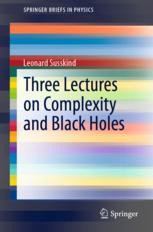
Susskind. Three Lectures on Complexity and Black Holes link.springer.com
Important connections between thermodynamics and complexity are proposed and discussed. Pedagogically written, serves as a fundamental introduction to black holes and their complex physical interpretation
-
Lean Proof Assistant lean-lang.org
Lean Proof Assistant.
-
Vaughan. CS260: Machine Learning Theory jennwv.com
A broad overview of the theoretical foundations underlying common machine learning algorithms.
-
Aho & Ullman. Foundations of Computer Science i.stanford.edu
A classic math-oriented introduction to computer science.
-
The Univalent Foundations Program Institute for Advanced Study. Homotopy Type Theory: Univalent Foundations of… homotopytypetheory.org
The present book is intended as a first systematic exposition of the basics of univalent foundations, and a collection of examples of this new style of reasoning — but without requiring the reader to know or learn any formal logic, or to use any computer proof assistant.
-
Lee. Randomized Algorithms and Probabilistic Analysis. Washington. homes.cs.washington.edu
Topics include Discrete probability, High-dimensional geometry and statistics, Information and entropy, and Markov chains and convergence to equilibrium.
-
Madhur Tulsiani. Mathematical Toolkit home.ttic.edu
Things prof. Madhur wish he knew in first year of grad school.
-
Demaine, Gasarch & Hajiaghayi. Computers and Intractability: A Guide to Algorithmic Lower Bounds hardness.mit.edu
A sequel to Garey and Johnson's Computers and Intractability: A Guide to NP-Completeness. New topics include Parameterized Complexity, Lower bounds on approximation, Other hardness assumptions (ETH, 3SUM-conjecture, APSP-conjecture, UGC, Others), Online Algorithms, Streaming…
-
Theory Announcements dmatheorynet.blogspot.com
DMANET spreads information on conferences, workshops, seminars etc. relating to discrete mathematics and algorithms.
-
CS Theory Jobs cstheory-jobs.org
TCS Jobs announcements.
-
Aspnes. Notes on Discrete Mathematics cs.yale.edu
Fall 2017 of the Yale course CPSC 202a, Mathematical Tools for Computer Science.
-
Watrous. Introduction to The Theory of Computing cs.uwaterloo.ca
undergrad introduction to theory of computation
- next page of items loading…