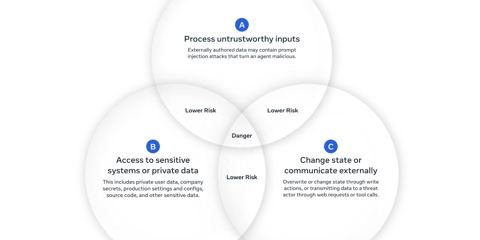
New Prompt Injection Papers: Agents Rule of Two and The Attacker Moves Second
Simon Willison's Nov 2025 commentary on both landmark papers, including the finding that 12 published defenses were bypassed at >90% success rate using gradient descent and RL-based adaptive attacks.
- from
- Prompt Injection
- added
- 2026-10-10
- likes
- 0
similar
-
Prompt Injection 2.0: Hybrid AI Threats arxiv.org
Jul 2025 paper showing how prompt injections now combine with XSS, CSRF, AI worm propagation, and multi-agent infections to evade traditional WAFs entirely. Evaluates Preamble's classifier, data-tagging, and RL-based defenses against these hybrid scenarios.
-
Oct 2025 paper systematically breaking 12 published defenses using gradient descent, RL, random search, and human-guided exploration. Most defenses originally claimed near-zero attack success rates; adaptive attacks exceeded 90% against all of them.
-
Securing AI Agents Against Prompt Injection Attacks arxiv.org
Nov 2025 benchmark of 847 adversarial test cases across 5 attack categories against 7 LLMs. The combined defense framework reduces attack success from 73.2% to 8.7% while retaining 94.3% of baseline task performance.
-
The Landscape of Prompt Injection Threats in LLM Agents (SoK) arxiv.org
Feb 2026 systematization-of-knowledge paper with a unified taxonomy covering attack payload strategies (heuristic vs. optimisation-based) and defense intervention stages (text, model, execution). Introduces the AgentPI benchmark for context-dependent agent tasks that all prior…
-
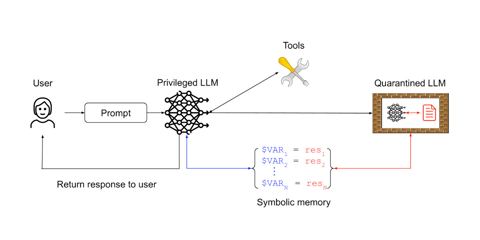
Design Patterns for Securing LLM Agents against Prompt Injections simonwillison.net
Overview of various strategies to mitigate the risk of prompt injection.
-
Improving LLM Security Against Prompt Injection: AppSec Guidance For Pentesters and Developers – Part 2 blog.includesecurity.com
Understanding Transformer Models (especially attention), Causes and How Do We Stop Prompt Injection.





Prompt Injection › Articles and Blog posts: “Simon Willison's Nov 2025 commentary on both landmark papers, including the finding that 12 published defenses were bypassed at >90% success rate using gradient descent and RL-based adaptive attacks.”