InjecGuard
Open-source prompt guard with published training data; achieves +30.8% over prior state-of-the-art on the NotInject benchmark, specifically addressing overdefense false positives that break legitimate use cases.
- from
- Prompt Injection
- added
- 2026-10-10
- likes
- 0
similar
-
prompt-shield github.com
Self-learning prompt injection detection engine with novel cross-domain techniques: Smith-Waterman sequence alignment (bioinformatics), stylometric discontinuity detection (forensic linguistics), and adversarial fatigue tracking (materials science). 27 detectors, 6 output…
-
ai-prompt-ctf by c-goosen github.com
One of the few CTFs that tests indirect injection against tool-calling agents, spanning RAG, function calling, and ReAct agent scenarios using LlamaIndex, ChromaDB, GPT-4o, and Llama 3.2.
-
How AI Prompt Injection Works | Hands-on with LLMs youtube.com
Jan 2026 AppSecEngineer tutorial with a code-level demo of injecting against a real LLM application and live testing of LLM Guard detection. One of the most practical end-to-end tutorials published to date.
-
Garak github.com
Automate looking for hallucination, data leakage, prompt injection, misinformation, toxicity generation, jailbreaks, and many other weaknesses in LLM's.
-
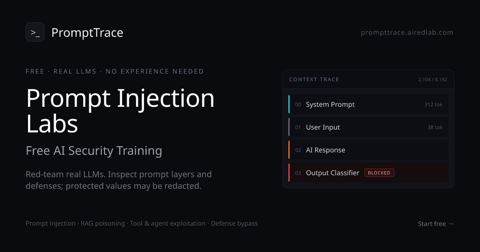
PromptTrace prompttrace.airedlab.com
Free AI security training platform with 7 hands-on prompt injection labs and a 15-level CTF (the Gauntlet) with progressively harder defenses, from prompt-level rules to code guards to LLM classifiers. Unique feature: Context Trace shows the full prompt stack (system prompt…
-
Securing AI Agents Against Prompt Injection Attacks arxiv.org
Nov 2025 benchmark of 847 adversarial test cases across 5 attack categories against 7 LLMs. The combined defense framework reduces attack success from 73.2% to 8.7% while retaining 94.3% of baseline task performance.

Prompt Injection › Tools: “Open-source prompt guard with published training data; achieves +30.8% over prior state-of-the-art on the NotInject benchmark, specifically addressing overdefense false positives that break legitimate use cases.”