Artificial Intelligence for Retrosynthetic Planning Needs Both Data and Expert Knowledge
Journal of the American Chemical Society, 2024. [All Versions]. The development of AI synthesis planners trained solely on reaction-example-data has stagnated and is not on par with the performance of “hybrid” algorithms combining AI with expert knowledge. This Perspective…
- from
- AGI & CoCoSci
- added
- 2026-10-10
- likes
- 0
similar
-
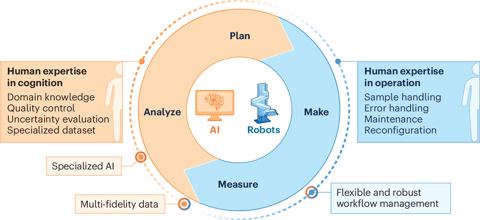
Balancing autonomy and expertise in autonomous synthesis laboratories nature.com
Nature Computational Science, 2025. [All Versions]. Autonomous synthesis laboratories promise to streamline the plan–make–measure–analyze iteration loop. Here, the authors comment on the barriers in the field, the promise of a human on-the-loop approach, and strategies for…
-
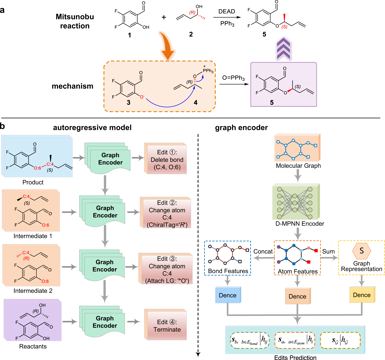
Retrosynthesis prediction using an end-to-end graph generative architecture for molecular graph editing nature.com
Nature Communications, 2023. [All Versions]. Retrosynthesis planning, the process of identifying a set of available reactions to synthesize the target molecules, remains a major challenge in organic synthesis. Recently, computer-aided synthesis planning has gained renewed…
-
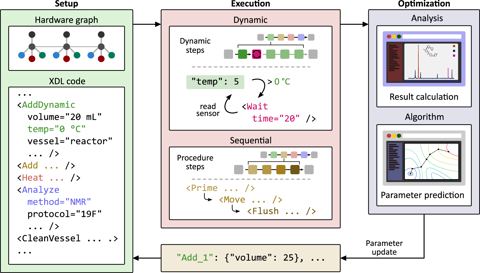
An integrated self-optimizing programmable chemical synthesis and reaction engine nature.com
Nature Communications, 2024. [All Versions]. Robotic platforms for chemistry are developing rapidly but most systems are not currently able to adapt to changing circumstances in real-time. This paper presents a dynamically programmable system capable of making, optimizing, and…
-
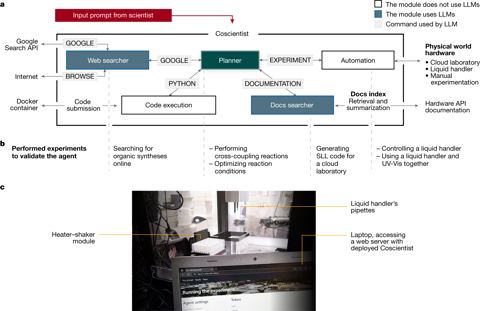
Autonomous chemical research with large language models nature.com
Nature, 2023. [All Versions]. An artificial intelligence system driven by GPT-4 that autonomously designs, plans and performs complex experiments by incorporating large language models empowered by tools such as internet and documentation search, code execution and experimental…
-
Evaluating and Modeling Social Intelligence: A Comparative Study of Human and AI Capabilities escholarship.org
CogSci'24, 2024. [All Versions]. This work eveloped a comprehensive theoretical framework for social dynamics and introduced two evaluation tasks: Inverse Reasoning (IR) and Inverse Inverse Planning (IIP). The approach also encompassed a computational model based on recursive…
-
Scientific discovery in the age of artificial intelligence nature.com
Nature, 2023. [All Versions]. A review article that examines breakthroughs over the past decade that include self-supervised learning, which allows models to be trained on vast amounts of unlabelled data, and geometric deep learning, which leverages knowledge about the…
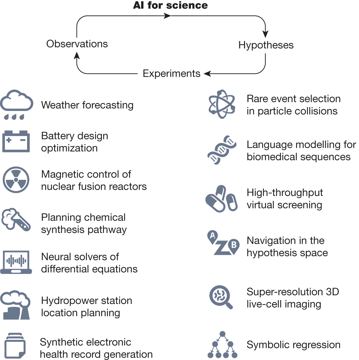
AGI & CoCoSci › Papers > Science Logology > AI Assisted Research: “Journal of the American Chemical Society, 2024. [All Versions]. The development of AI synthesis planners trained solely on reaction-example-data has stagnated and is not on par with the performance of “hybrid” algorithms combining AI with expert knowledge. This Perspective…”