The Scene Language: Representing Scenes with Programs, Words, and Embeddings
CVPR'25, 2025. [All Versions]. [Project]. This paper introduces the Scene Language, a visual scene representation that concisely and precisely describes the structure, semantics, and identity of visual scenes. It represents a scene with three key components: a program that…

- from
- AGI & CoCoSci
- added
- 2026-10-10
- likes
- 0
similar
-
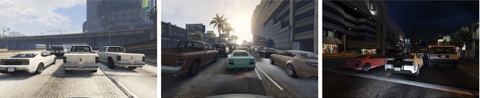
Scenic: a language for scenario specification and data generation link.springer.com
Machine Learning, 2022. [All Versions]. This paper proposes a domain-specific language, Scenic, for describing scenarios that are distributions over scenes and the behaviors of their agents over time. Scenic combines concise, readable syntax for spatiotemporal relationships…
-
3D dynamic scene graphs: Actionable spatial perception with places, objects, and humans arxiv.org
RSS'20, 2020. [All Versions]. This paper presents a unified representation for actionable spatial perception: 3D Dynamic Scene Graphs. Scene graphs are directed graphs where nodes represent entities in the scene (e.g. objects, walls, rooms), and edges represent relations (e.g…
-
The Neuro-Symbolic Concept Learner: Interpreting Scenes, Words, and Sentences From Natural Supervision arxiv.org
ICLR'19, 2019. [All Versions].
-
Visual Programming: Compositional Visual Reasoning Without Training openaccess.thecvf.com
CVPR'23, 2023. [All Versions]. VISPROG, a neuro-symbolic approach to solving complex and compositional visual tasks given natural language instructions, using the in-context learning ability of large language models to generate python-like modular programs, which are then…
-
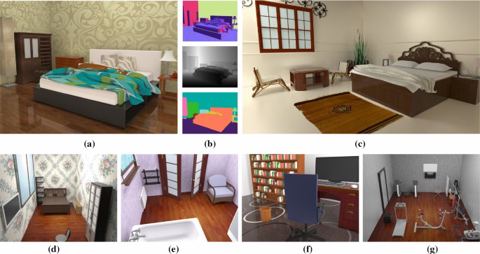
Configurable 3D Scene Synthesis and 2D Image Rendering with Per-pixel Ground Truth Using Stochastic Grammars link.springer.com
International Journal of Computer Vision, 2018. [All Versions]. [Preprint]. This work proposes a systematic learning-based approach to the generation of massive quantities of synthetic 3D scenes and arbitrary numbers of photorealistic 2D images thereof, with associated ground…
-
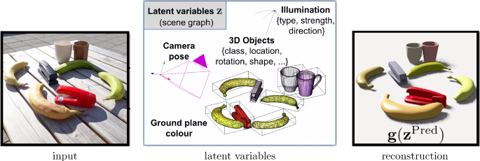
Structured Generative Models for Scene Understanding link.springer.com
International Journal of Computer Vision, 2025. [All Versions]. This position paper argues for the use of structured generative models (SGMs) for the understanding of static scenes. This requires the reconstruction of a 3D scene from an input image (or a set of multi-view…

AGI & CoCoSci › Papers > Domain Specific Language > Declarative DSL Applications: “CVPR'25, 2025. [All Versions]. [Project]. This paper introduces the Scene Language, a visual scene representation that concisely and precisely describes the structure, semantics, and identity of visual scenes. It represents a scene with three key components: a program that…”