ChipNeMo: Domain-Adapted LLMs for Chip Design
2023. [All Versions]. ChipNeMo aims to explore the applications of large language models (LLMs) for industrial chip design. Instead of directly deploying off-the-shelf commercial or open-source LLMs, the authors instead adopt the following domain adaptation techniques…

- from
- AGI & CoCoSci
- added
- 2026-10-10
- likes
- 0
similar
-
LLMOps: Building Real-World Applications With Large Language Models comet.com
Learn to build modern software with LLMs using the newest tools and techniques in the field.
-
Augmenting large language models with chemistry tools nature.com
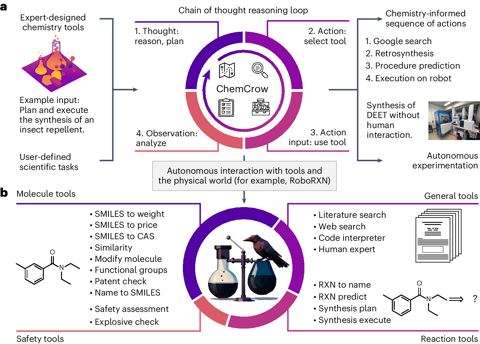
Nature Machine Intelligence, 2023. [All Versions]. [Preprint]. This paper introduces ChemCrow, an LLM chemistry agent designed to accomplish tasks across organic synthesis, drug discovery and materials design. By integrating 18 expert-designed tools and using GPT-4 as the LLM…
-
Neural Logic Machines arxiv.org
ICLR'19, 2019. [All Versions].
-
Large language models for scientific discovery in molecular property prediction nature.com
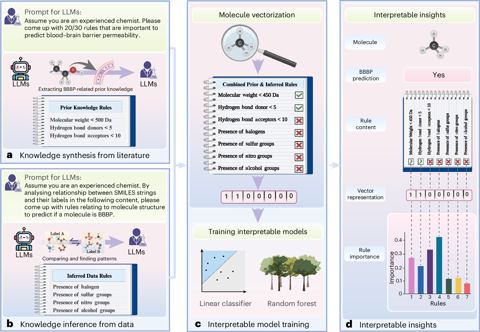
Nature Machine Intelligence, 2025. [All Versions]. Large language models (LLMs) are a form of artificial intelligence system encapsulating vast knowledge in the form of natural language. These systems are adept at numerous complex tasks including creative writing, storytelling…
-
Llama llama.com
Meta's open source large language model. #opensource
-
From task structures to world models: what do LLMs know? cell.com
Trends in Cognitive Sciences, 2024. [All Versions]. [Preprint]. In what sense does a large language model (LLM) have knowledge? The authors answer by granting LLMs ‘instrumental knowledge’: knowledge gained by using next-word generation as an instrument. The authors then ask…


AGI & CoCoSci › Papers > Science Logology > AI Assisted Research: “2023. [All Versions]. ChipNeMo aims to explore the applications of large language models (LLMs) for industrial chip design. Instead of directly deploying off-the-shelf commercial or open-source LLMs, the authors instead adopt the following domain adaptation techniques…”