Math
Mathematics: proofs, geometry, calculus, linear algebra, probability, statistics, and math explained visually.
-
First cs.ubc.ca
and Second Course in Randomized Algorithms. Columbia. - Respectively, undergrad and grad courses for probabilistic methods in algorithms.
-
Rubinstein & Weinberg. Research Masters in TCS cs.princeton.edu
A list of master programs in TCS.
-
Livni. COS 511 Theoretical Machine Learning. Princeton cs.princeton.edu
Formally define and study various models that have been proposed for learning. The course will present and contrast the statistical, computational and online models for learning. We will present and rigorously analyze some of the most successful algorithms in machine learning…
-
Arora. Overcoming Intractability in Machine Learning cs.princeton.edu
A seminar course that will focus on the following phenomenon: many problems in machine learning are formally intractable (e.g., NP-hard). Nevertheless they are solved in practice by heuristics. Can we design algorithms with provable guarantees (running time, solution quality)?
-
Arora. The Computational Universe cs.princeton.edu
Takes us on a broad sweep of scientific knowledge and related technologies: propositional logic of the ancient Greeks (microprocessors); quantum mechanics (silicon chips); network and system phenomena (internet and search engines); computational intractability (secure…
-
Arora. Advanced Algorithm Design cs.princeton.edu
Notably uses ideas such as randomness, approximation, high dimensional geometry. Faces uncertainty, approaches to handle big data, handling intractability, heuristic approaches, ..etc.
-
Arora. Thinking Like a Theorist. Princeton cs.princeton.edu
It covers a large number of the math/CS topics that you need to know for reading and doing research in Computer Science Theory.
-
Arora. A Theorist's Toolkit. Princeton cs.princeton.edu
Aimed primarily at first and second year graduate students who plan to do research in theoretical computer science. We will introduce probabilistic, algebraic, combinatorial, and algorithmic methods useful in proofs.
-
Koutsoupias. Probability and Computing. Oxford cs.ox.ac.uk
Introduction to probabilistic methods in computer science.
-
Robert Robere. Proof Complexity: Algorithms and Lower Bounds cs.mcgill.ca
An introduction to modern proof complexity, emphasizing its connections with computational complexity and algorithms in optimization.
-
Eva Tardos. Algorithmic Game Theory cs.cornell.edu
It combines algorithmic thinking with game-theoretic, or, more generally, economic concepts. The course will study a range of topics at this interface. The only prerequisite to the course is mathematical thinking.
-
Halpern. CS 2802: Discrete Structures - Honors. 2020. Cornell cs.cornell.edu
Honors lecture notes on discrete math - Homework
-
O'Donnell. A Theorist's Toolkit. CMU cs.cmu.edu
It covers a large number of the math/CS topics that you need to know for reading and doing research in Computer Science Theory.
-
Blum. You and Your Research: An Advice to a Beginning Graduate Student cs.cmu.edu
Manuel Blum, A very popular figure in TCS, gives research advices for juniors.
-
Blum. Intro Machine Learning Theory cs.cmu.edu
.
-
Introduction to Discrete Mathematics for Computer Science. UC San-Diego coursera.org
Learn the language of Computer Science. Learn the math that defines computer science, and practice applying it through mathematical proofs and Python code.
-
Cambridge Foundations of CS cl.cam.ac.uk
It teaches programming and presents some fundamental principles of computer science, especially algorithm design.
-
Apt & Grädel. Lectures in Game Theory for Computer Scientists cambridge.org
Games provide mathematical models for interaction, and numerous tasks in computer science can be formulated in game-theoretic terms.
-
Shalev-Shwartz. Understanding Machine Learning: From Theory to Algorithms cambridge.org
It provides an extensive theoretical account of the fundamental ideas underlying machine learning and the mathematical derivations that transform these principles into practical algorithms.
-
Tu Delft. Delftse Foundations of Computation books.open.tudelft.nl
A textbook for a one quarter introductory course in theoretical computer science including logic, proof techniques, and set theory. It assumes no prerequisite other than basic programming.
-
Princeton's Companion. Advice to a Young Mathematician assets.press.princeton.edu
Five contributors draw on their experiences of mathematical life and research, and to offer advice that they might have liked to receive when they were just setting-out on their careers.
-
Rudich & Wigderson. Computational Complexity Theory ams.org
Three weeks of lectures from the IAS/Park City Mathematics Institute Summer School on computational complexity. Topics include reductions, lower-bounds, average-case complexity, randomness, interactive proof systems, probabilistically checkable proofs, quantum computing, and…
-
Walter Dean. Computational Complexity Theory and the Philosophy of Mathematics academic.oup.com
It highlights the significance of complexity theory relative to questions traditionally asked by philosophers of mathematics while also attempting to isolate some new ones.
-
Introduction to Classical and Quantum Computing thomaswong.net
Introductory quantum computing textbook. The only prerequisite is trigonometry, and it teaches the math along the way.
-
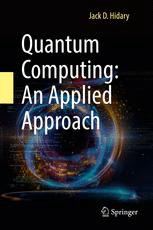
Quantum Computing: An Applied Approach springer.com
A hands on introduction into quantum computing that explains the foundations of quantum computing to the mathematics behind quantum systems.
-
Quantum Computing: A Gentle Introduction mmrc.amss.cas.cn
Explains quantum computing with only basic college maths knowledge needed.
-
Quantum Computation and Quantum Information mmrc.amss.cas.cn
Comprehensive textbook for those with some prior knowledge in mathematics, computer science and physics.
-
Quantum Computing with Amazon Braket SDK manning.com
Manning liveProject series that introduces Braket API and guides the learner through implementation of several simple algorithms.
-
QWorld's Bronze-Qiskit gitlab.com
Very accessible computation/programming oriented tutorials. It begins from basics of matrices up to grover's algorithm. There are also accompanying videos which explain the tutorials.
-
Understanding Quantum Computers futurelearn.com
Introduction to the key concepts of quantum computing with minimal mathematics.
-
Dawid Kopczyk dkopczyk.quantee.co.uk
Quantum algorithms explained to data scientists with visualisations.
-
Quantum Computing. Less Formulas - More Understanding coursera.org
Same professor of the previous course, this time more focused on quantum concepts rather than math.
-
The Introduction To Quantum Computing coursera.org
A subtle introduction to computation, the math behind it and its quantum counterparts followed by in-depth discussion of a few quantum algorithms.
-
Brilliant.org Quantum Computing brilliant.org
Explanations through problems. Curated along with Microsoft and Alphabet X.
-
Quantum Computing Explained amazon.com
Conversational approach to explaining quantum computing with worked solutions.
-
Quantum Computing for Computer Scientists amazon.com
Quantum computing explained using an approach accessible to undergraduate computer science students.
-
An Introduction to Quantum Computing amazon.com
Strikes an excellent balance between accessiblity and mathematical rigour. It is suitable for undergraduate students.
-
Doop plast-lab.github.io
Doop is a declarative framework for static analysis of Java/Android programs, centered on pointer analysis algorithms. Doop provides a large variety of analyses and also the surrounding scaffolding to run an analysis end-to-end (fact generation, processing, statistics, etc.).
-
DrNim nim-lang.org
DrNim combines the Nim frontend with the Z3 proof engine in order to allow verify / validate software written in Nim.
-
Polyspace Code Prover mathworks.com
copyright: — Provide code verification that proves the absence of overflow, divide-by-zero, out-of-bounds array access, and certain other run-time errors in C and C++ source code.
-
To reduce biases in machine learning start with openly discussing the problem enterprisersproject.com
Bias in Relevance.
-
CBMC cprover.org
Bounded model-checker for C programs, user-defined assertions, standard assertions, several coverage metric analyses.
-
Tensor Calculus and the Calculus of Moving Surfaces youtube.com
Generalize properly how Tensors work, yet just watching a few videos already helps a lot to grasp the concepts.
-
The real reason most ML projects fail towardsdatascience.com
Focus on clear business objectives, avoid pivots of algorithms unless you have really clean code, and be able to know when what you coded is "good enough".
-
Neural Networks and Deep Learning, ch.4 neuralnetworksanddeeplearning.com
A visual proof that neural nets can compute any function.
-
Naver naver.com
This is a Korean search engine - best used with Google Translate, ironically. Surprisingly, sometimes deep learning search results and comprehensible advanced math content shows up more easily there than on Google search.
-
Neural Networks, Manifolds, and Topology colah.github.io
Fresh look on how neurons map information.
-
Artificial Neural Networks: Mathematics of Backpropagation briandolhansky.com
Picturing backprop, mathematically.
-
MathBox, Tools for Thought Graphical Algebra and Fourier Analysis acko.net
New look on Fourier analysis.
-
Animate Your Way to Glory - Part II, Math and Physics in Motion acko.net
Nice animations for rotation and rotation interpolation with Quaternions, a mathematical object for handling 3D rotations.
- next page of items loading…