The secret life of predictive brains: what's spontaneous activity for?
Trends in Cognitive Sciences, 2021. [All Versions]. A neuroscience account on brain as a generative model.
- from
- AGI & CoCoSci
- added
- 2026-10-10
- likes
- 0
similar
-
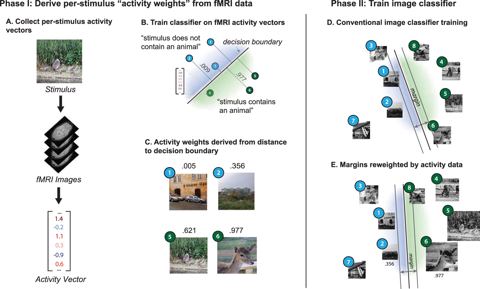
Using human brain activity to guide machine learning nature.com
Scientific Report, 2018. [All Versions].
-
Bayesian Brains without Probabilities sciencedirect.com
Trends in Cognitive Sciences, 2016. [All Versions]. A perspective on human probabilistic modeling without explicit probabilistic computation.
-
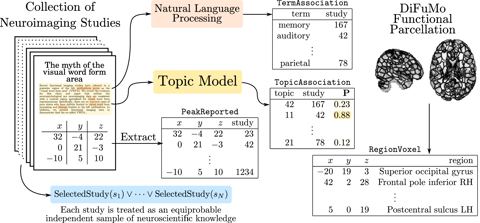
Meta-analysis of the functional neuroimaging literature with probabilistic logic programming nature.com
Scientific Reports, 2022. [All Versions]. Inferring reliable brain-behavior associations requires synthesizing evidence from thousands of functional neuroimaging studies through meta-analysis. However, existing meta-analysis tools are limited to investigating simple…
-
A computational model of scientific insight escholarship.org
The nature of creativity: Contemporary psychological perspectives, 1988. [All Versions]. A computational account on insights for scientific discovery.
-
Generalization, similarity, and Bayesian inference cambridge.org
Behavioral and Brain Sciences, 2001. [All Versions]. [Preprint]. Shepard has argued that a universal law should govern generalization across different domains of perception and cognition, as well as across organisms from different species or even different planets. Starting…
-
Generating new concepts with hybrid neuro-symbolic models. arxiv.org
CogSci'20, 2020. [All Versions].

AGI & CoCoSci › Papers > Meta-Level Considerations > Cognitive Architecture: “Trends in Cognitive Sciences, 2021. [All Versions]. A neuroscience account on brain as a generative model.”