Two Forms of Knowledge Representations in the Human Brain
Neuron, 2020. [All Versions]. Illustrating language-derived and sensory-derived knowledge.
- from
- AGI & CoCoSci
- added
- 2026-10-10
- likes
- 0
similar
-
Natural speech reveals the semantic maps that tile human cerebral cortex nature.com
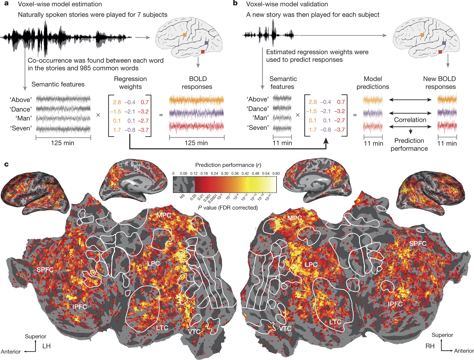
Nature, 2016. [All Versions]. [Preprint]. [Code & Tutorial]. The meaning of language is represented in regions of the cerebral cortex collectively known as the ‘semantic system’. However, little of the semantic system has been mapped comprehensively, and the semantic…
-
Semantic projection recovers rich human knowledge of multiple object features from word embeddings nature.com
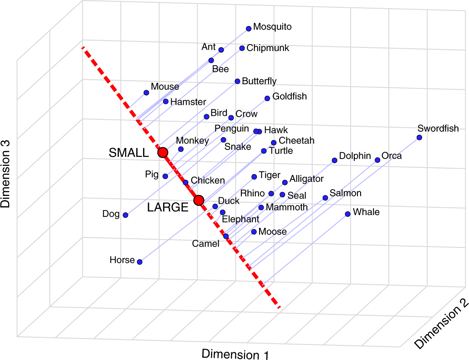
Nature Human Behavior, 2022. [All Versions]. [Preprint]. How is knowledge about word meaning represented in the mental lexicon? Current computational models infer word meanings from lexical co-occurrence patterns. They learn to represent words as vectors in a multidimensional…
-
A continuous semantic space describes the representation of thousands of object and action categories across the human… mri-q.com
Neuron, 2012. [All Versions].
-
Dual coding of knowledge in the human brain sciencedirect.com
Trends in Cognitive Sciences, 2021. [All Versions]. Yanchao Bi's review on neuroscience experiments on dual coding theory.
-
Representations of Commonsense Knowledge sciencedirect.com
Morgan Kaufmann, 1990. [All Versions]. A classic book on commonsense knowledge.
-
Structuring Knowledge with Cognitive Maps and Cognitive Graphs cell.com
Trends in Cognitive Sciences, 2021. [All Versions]. [Preprint]. Humans and animals use mental representations of the spatial structure of the world to navigate. The classical view is that these representations take the form of Euclidean cognitive maps, but alternative theories…
AGI & CoCoSci › Papers > System 1 & System 2 > Dual-Coding Theory: “Neuron, 2020. [All Versions]. Illustrating language-derived and sensory-derived knowledge.”