Structuring Knowledge with Cognitive Maps and Cognitive Graphs
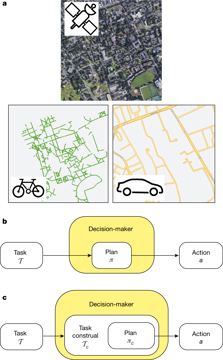
Trends in Cognitive Sciences, 2021. [All Versions]. [Preprint]. Humans and animals use mental representations of the spatial structure of the world to navigate. The classical view is that these representations take the form of Euclidean cognitive maps, but alternative theories…
- from
- AGI & CoCoSci
- added
- 2026-10-10
- likes
- 0
similar
-
Organizing conceptual knowledge in humans with a gridlike code science.org
Science, 2016. [All Versions]. [Preprint]. It has been hypothesized that the brain organizes concepts into a mental map, allowing conceptual relationships to be navigated in a manner similar to that of space. Grid cells use a hexagonally symmetric code to organize spatial…
-
Navigating cognition: Spatial codes for human thinking science.org
Science, 2018. [All Versions]. [Preprint]. The hippocampal formation has long been suggested to underlie both memory formation and spatial navigation. This work discusses how neural mechanisms identified in spatial navigation research operate across information domains to…
-
Why concepts are (probably) vectors cell.com
Trends in Cognitive Sciences, 2024. [All Versions]. For decades, cognitive scientists have debated what kind of representation might characterize human concepts. Whatever the format of the representation, it must allow for the computation of varied properties, including…
-
People construct simplified mental representations to plan nature.com
Nature, 2022. [All Versions]. A computational account on rational problem representation in human planning.
-
Hippocampal neurons construct a map of an abstract value space sciencedirect.com
Cell, 2021. [All Versions].
-
Towards an Architecture for Cognitive Vision Using Qualitative Spatio-temporal Representations and Abduction link.springer.com
Spatial Cognition, 2002. [All Versions].
AGI & CoCoSci › Papers > Concepts > Human Concept Representation: “Trends in Cognitive Sciences, 2021. [All Versions]. [Preprint]. Humans and animals use mental representations of the spatial structure of the world to navigate. The classical view is that these representations take the form of Euclidean cognitive maps, but alternative theories…”