Expert-level protocol translation for self-driving labs
NeurIPS'24, 2024. [All Versions]. [Project]. Recent development in Artificial Intelligence (AI) models has propelled their application in scientific discovery, but the validation and exploration of these discoveries require subsequent empirical experimentation. The concept of…
- from
- AGI & CoCoSci
- added
- 2026-10-10
- likes
- 0
similar
-
Hierarchically Encapsulated Representation for Protocol Design in Self-Driving Labs openreview.net
ICLR'25, 2025. [All Versions]. [Project]. Self-driving laboratories have begun to replace human experimenters in performing single experimental skills or predetermined experimental protocols. However, as the pace of idea iteration in scientific research has been intensified by…
-
Program Synthesis Guided Reinforcement Learning proceedings.neurips.cc
NeurIPS'21, 2021. [All Versions].
-
Communicating Natural Programs to Humans and Machines proceedings.neurips.cc
NeurIPS'22, 2022. [All Versions]. While humans readily generate and interpret instructions in a general language, computer systems are shackled to a narrow domain-specific language that they can precisely execute. This makes building intelligent systems that can generalize to…
-
Enhancing Robot Program Synthesis Through Environmental Context proceedings.neurips.cc
NeurIPS'23, 2023. [All Versions]. Program synthesis aims to automatically generate an executable program that conforms to the given specification. Recent advancements have demonstrated that deep neural methodologies and large-scale pretrained language models are highly…
-
Balancing autonomy and expertise in autonomous synthesis laboratories nature.com
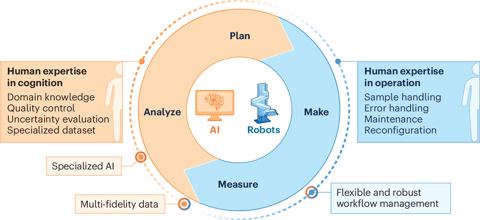
Nature Computational Science, 2025. [All Versions]. Autonomous synthesis laboratories promise to streamline the plan–make–measure–analyze iteration loop. Here, the authors comment on the barriers in the field, the promise of a human on-the-loop approach, and strategies for…
-
Autonomous chemical research with large language models nature.com
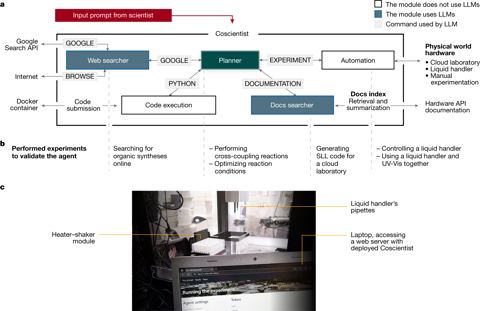
Nature, 2023. [All Versions]. An artificial intelligence system driven by GPT-4 that autonomously designs, plans and performs complex experiments by incorporating large language models empowered by tools such as internet and documentation search, code execution and experimental…
AGI & CoCoSci › Papers > Domain Specific Language > DSL Program Synthesis: “NeurIPS'24, 2024. [All Versions]. [Project]. Recent development in Artificial Intelligence (AI) models has propelled their application in scientific discovery, but the validation and exploration of these discoveries require subsequent empirical experimentation. The concept of…”