Phylogenetic evidence for Sino-Tibetan origin in northern China in the Late Neolithic
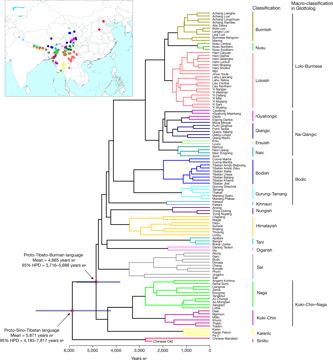
Nature, 2019. [All Versions]. A Bayesian phylogenetic analysis on two competing hypotheses of the origin of the Sino-Tibetan language family suggests that the initial expansion of Sino-Tibetan languages occurred approximately 4,000–6,000 years before present (BP; taken as AD…
- from
- AGI & CoCoSci
- added
- 2026-10-10
- likes
- 0
similar
-
Triangulation supports agricultural spread of the Transeurasian languages nature.com
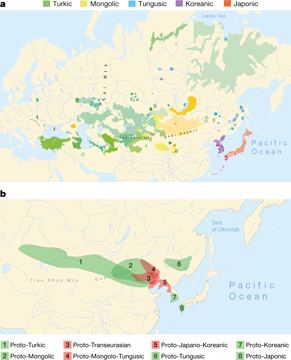
Nature, 2021. [All Versions]. [Nature News]. A triangulation of linguistic, archaeological and genetic data suggests that the Transeurasian language family originated in a population of grain farmers in China around 9,000 years ago, and that agriculture underpinned its spread.
-
Synthesizing theories of human language with Bayesian program induction cap.csail.mit.edu
Nature Communications, 2022. [All Versions].
-
Shared computational principles for language processing in humans and deep language models nature.com
Nature Neuroscience, 2022. [All Versions].
-
Synthesizing theories of human language with Bayesian program induction nature.com
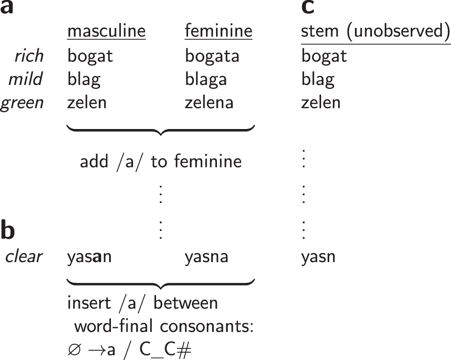
Nature Communications, 2022. [All Versions]. Automated, data-driven construction and evaluation of scientific models and theories is a long-standing challenge in artificial intelligence. This work presents a framework for algorithmically synthesizing models of a basic part of…
-
From language development to language evolution: A unified view of human lexical creativity science.org
Science, 2023. [All Versions]. [Preprint]. This work supports a unified foundation for human lexical creativity underlying both the fleeting products of individual ontogeny and the evolutionary products of phylogeny across languages.
-
The language of generalization psycnet.apa.org
Psychological Review, 2019. [All Versions].
AGI & CoCoSci › Papers > Evolutionary Intelligence: “Nature, 2019. [All Versions]. A Bayesian phylogenetic analysis on two competing hypotheses of the origin of the Sino-Tibetan language family suggests that the initial expansion of Sino-Tibetan languages occurred approximately 4,000–6,000 years before present (BP; taken as AD…”