Rational quantitative attribution of beliefs, desires and percepts in human mentalizing
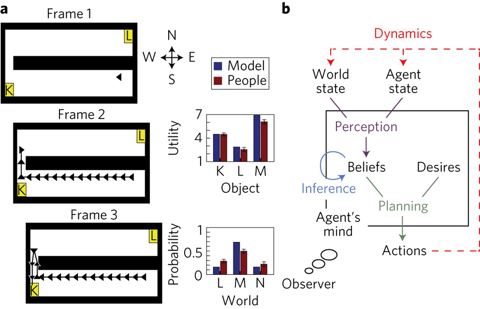
Nature Human Behavior, 2017. [All Versions]. [Preprint]. This paper presents a model of core mentalizing computations: inferring jointly an actor’s beliefs, desires and percepts from how they move in the local spatial environment. The proposed Bayesian theory of mind (BToM)…
- from
- AGI & CoCoSci
- added
- 2026-10-10
- likes
- 0
similar
-
Bayesian Theory of Mind: Modeling Joint Belief-Desire Attribution escholarship.org
CogSci'11, 2011. [All Versions]. [Preprint]. This paper presents a computational framework for understanding Theory of Mind (ToM): the human capacity for reasoning about agents’ mental states such as beliefs and desires. The proposed Bayesian model of ToM (or BToM) expresses…
-
Machine theory of mind proceedings.mlr.press
ICML'18, 2018. [All Versions]. Theory of mind (ToM) broadly refers to humans’ ability to represent the mental states of others, including their desires, beliefs, and intentions. This work proposes a Theory of Mind neural network --- a ToMnet --- which uses meta-learning to…
-
Theory of mind as inverse reinforcement learning sciencedirect.com
Current Opinion in Behavioral Sciences, 2019. [All Versions]. This paper reviews the idea that Theory of Mind --- humans' ability to reason about other people's mental states --- can be formalized as inverse reinforcement learning. Under this framework, expectations about how…
-
People construct simplified mental representations to plan nature.com
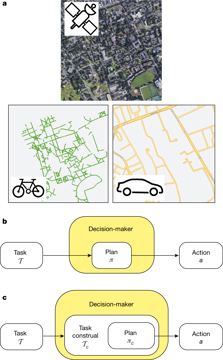
Nature, 2022. [All Versions]. A computational account on rational problem representation in human planning.
-
Theory of Minds: Understanding Behavior in Groups through Inverse Planning aaai.org
AAAI'19, 2019. [All Versions]. Towards the goal of building machine-learning algorithms with human-like social intelligence, this paper develops a generative model of multiagent action understanding based on a novel representation for these latent relationships called…
-
Computational Models of Emotion Inference in Theory of Mind: A Review and Roadmap onlinelibrary.wiley.com
Topics in Cognitive Science, 2019. [All Versions]. This paper proposes an intuitive theory framework to studying affective cognition—how humans reason about emotions—and derive a taxonomy of inferences within affective cognition. Using this taxonomy, the authors review formal…
AGI & CoCoSci › Papers > Theory of Mind: “Nature Human Behavior, 2017. [All Versions]. [Preprint]. This paper presents a model of core mentalizing computations: inferring jointly an actor’s beliefs, desires and percepts from how they move in the local spatial environment. The proposed Bayesian theory of mind (BToM)…”