Empowering biomedical discovery with AI agents
Cell, 2024. [All Versions]. The authors envision “AI scientists” as systems capable of skeptical learning and reasoning that empower biomedical research through collaborative agents that integrate AI models and biomedical tools with experimental platforms. Rather than taking…
- from
- AGI & CoCoSci
- added
- 2026-10-10
- likes
- 0
similar
-
The Virtual Lab of AI agents designs new SARS-CoV-2 nanobodies nature.com
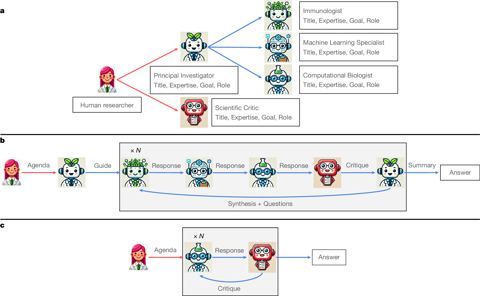
Nature, 2025. [All Versions]. Science frequently benefits from teams of interdisciplinary researchers, but many scientists do not have easy access to experts from multiple fields. Although large language models (LLMs) have shown an impressive ability to aid researchers across…
-
BioMedAgent github.com
Self-evolving multi-agent framework for autonomous biomedical data analysis with tool discovery, workflow planning, code generation, execution, correction, and cross-omics analysis.
-
BioAgents github.com
Multi-agent bioinformatics assistant using specialized language models and retrieval for genomics workflow development and troubleshooting.
-
DrugAgent github.com
Multi-agent biomedical evidence synthesis framework for computational drug discovery with reliability-aware aggregation.
-
Towards end-to-end automation of AI research nature.com
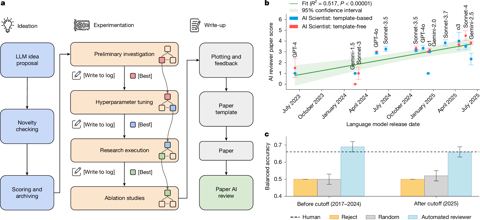
Nature, 2026. [All Versions]. The automation of science is a long-standing ambition in artificial intelligence (AI) research. Although the community has made substantial progress in automating individual components of the scientific process, a system that autonomously navigates…
-
Autonomous chemical research with large language models nature.com
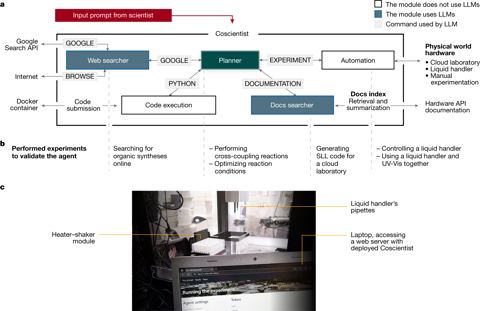
Nature, 2023. [All Versions]. An artificial intelligence system driven by GPT-4 that autonomously designs, plans and performs complex experiments by incorporating large language models empowered by tools such as internet and documentation search, code execution and experimental…
AGI & CoCoSci › Papers > Science Logology > AI Assisted Research: “Cell, 2024. [All Versions]. The authors envision “AI scientists” as systems capable of skeptical learning and reasoning that empower biomedical research through collaborative agents that integrate AI models and biomedical tools with experimental platforms. Rather than taking…”