Object Perception as Bayesian Inference
Annual Review of Psychology, 2004. [All Versions]. [Preprint]. We perceive the shapes and material properties of objects quickly and reliably despite the complexity and objective ambiguities of natural images. Typical images are highly complex because they consist of many…
- from
- AGI & CoCoSci
- added
- 2026-10-10
- likes
- 0
similar
-
The Adaptive Nature of Human Categorization Behavior act-r.psy.cmu.edu
Psychological Review, 1991. [All Versions]. The original paper that relates cognitive resource limitation with Bayesian rational analysis, in the case of categorization behavior.
-
The Perception of Relations perception.jhu.edu
Trends in Cognitive Sciences, 2021. [All Versions]. Chaz Firestone's review on the perception of relation, in constrast to the conventional reasoning view.
-
Visual complexity: a review researchgate.net
Psychological Bulletin, 2006. [All Versions]. [APA]. A psychological account on visual complexity.
-
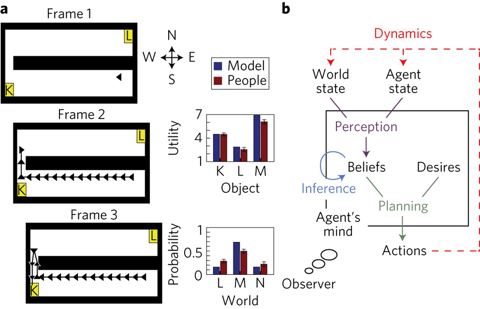
Rational quantitative attribution of beliefs, desires and percepts in human mentalizing nature.com
Nature Human Behavior, 2017. [All Versions]. [Preprint]. This paper presents a model of core mentalizing computations: inferring jointly an actor’s beliefs, desires and percepts from how they move in the local spatial environment. The proposed Bayesian theory of mind (BToM)…
-
Humans can decipher adversarial images perception.jhu.edu
Nature Communications. 2019. [All Versions].
-
Bayesian modeling of human concept learning proceedings.neurips.cc
NeurIPS'98, 1998. [All Versions]. [Preprint]. This work considers the problem of learning concepts from small numbers of positive examples, a feat which humans perform routinely but which computers are rarely capable of. Bridging machine learning and cognitive science…
AGI & CoCoSci › Papers > Bayesian Modeling > Generative Model: “Annual Review of Psychology, 2004. [All Versions]. [Preprint]. We perceive the shapes and material properties of objects quickly and reliably despite the complexity and objective ambiguities of natural images. Typical images are highly complex because they consist of many…”