Open source and the future of hardware
Talk by Neil Gershenfeld.
transcript
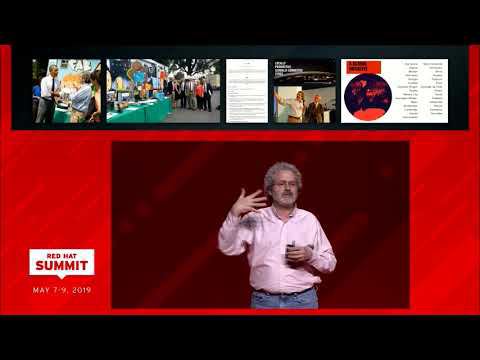
please welcome director MIT Center for bits and atoms and chair of fab foundation professor Neil Gershenfeld so let me start by instead of you applauding me me applauding all of you this is a fabulous community it's a real pleasure to be here with you you can applaud yourself as you on I direct the Center for bits and atoms at MIT that works on the boundary of digital and physical which I've never understood I'm happy to take credit for the observation that computer science was one of the worst things ever to happen to either computers or to science because it's unphysical the theory of computer science violates physics and so we've been studying how you bring them back together and that led to things like the first quantum computations creating first synthetic life early a synthetic life coding in materials and it led to the beginning of what's now called the Internet of Things the crazy idea then of putting the Internet into things came out of thinking that thought and so merging digital to physical in turn led to amazing people like my student Jason who built and runs all the computers at Facebook and my student Rafi who built and runs all the computers at Twitter and that's strange because I'm not a computer scientist and I didn't teach them data centers but I taught them physics and their job is billions of dollars and millions of lots to make information and so you can't believe in software separate from hardware you need to merge them and so that's the kind of research we're doing at Center for bits and atoms what's coming out of that which is what I want to tell you about today is a remarkable scaling so the first real-time computer was the whirlwind made at MIT there was one of those it was commercialized as PDP's there is thousands of those that were used to create the internet that led to millions of hobbyist computers billions of personal computers trillions of internet of things what's happening now is the same thing for manufacturing so one computer controlled machining made at MIT in 1952 led to fab labs I'll tell you about led to machine making machines to assemblers to self assembler so we're really working on how to make the replicator and to get there prompted by the analogy with mini computers which is when the internet email video games word processing all of that happened we started setting up mini computers for fabrication my lab is tens of millions of dollars we set it up mini versions that would fit in about this much of the stage about a hundred thousand dollar investment and these fab labs like the mini computers accidentally went viral we set up one or two of them but they've been doubling every year and a half for 15 years and so what you see here is some of these interesting sab labs and locations from the far north of Norway to the bottom of Africa in these labs you can go from digital to physical and physical to digital and make almost anything so some of the examples here are consumer electronics you can make equipment to grow food you'll hear more about that urban infrastructure and one of the most interesting things you can make is the machines themselves increasingly you can go to a Fab Lab to make a Fab Lab to make more fab labs so digital to physical and physical to digital now this is really open-source hardware but open-source Hardware rests on open source software so we've built on us a pack a suite of great tools for open source software that we've had to compose so you can go from design to CAD to cam to machine control to motion control and actually make something historically those are separated they weren't designed around one person doing all of that we've had to build on open source software to merge it to create these integrated workflows to empower an individual to do digital fabrication and here's the scaling Gordon Moore made the most famous graph in history five points that he saw lining up it's this great article cramming more components that you should read if you haven't he forecast ten years of that he got everything right except for that it was 50 years of what came to be known as Moore's law what I'm showing you in the bottom graph is ten years of fab labs doubling straight-line on the log plot it's clearly exponential and so I won't make Gordon's mistake and say it'll go for ten years because it's already gone for ten years the real conclusion is this is going to go for 50 years Moore's law is ending for silicon but were just at the beginning of a Moore's law for the physical world going from digital to physical the science is there which I showed you quickly and the data is there so what does it mean to have 50 years of that scaling well here are some of the fab labs the one second in on the top is Bhutan which is based not on gross domestic product but gross national happiness they measure not how much money did you make but what is your well-being what is your health but they had to buy crap trucked in from India or China so that lab helps them make roasts national happiness physical picking up on the last group this is a lab in Hollen and Israel where mixed communities of Arabs and come together this is in Northern Ireland at the protestant-catholic boundary arts colony and main inner city Detroit these are these in remarkable places where these labs are flourishing to keep up with that we had to create a foundation for operational capacity and a very exciting program today I gave a class to a hundred sites around the world in the Saab Academy not for distance learning on a screen but for distributed learning where students have peers and work groups with mentors in these labs locally and then we connect them globally to tap more of the brain power of the planet bright inventive people wherever they are in the world and so once you can do that and once the slide updates it has these implications the picture towards the right is Barcelona's mayor Barcelona has 50 former mayor has 50% youth unemployment fabulous design sense but a whole generation can't work as we understand it today and so he's starting a 40 year countdown to urban self-sufficiency you expect the city to provide electricity or clean water it's now deploying these labs as part of the means to make in the city so you can produce what you consume and on the list there are a number of other cities joining Barcelona in this 40 year countdown on the left is we ran a lab right outside the window of the Oval Office it was funny was Secret Service bringing in high-power lasers but Obama loved it and what came out of the is legislation in Congress right now for universal access to digital fabrication in the same way we have access to communication and computation now the idea is there should be universal access to the means to make as a national scale initiative and that's a bill in Congress right now and what that leads to is among the most sensitive issues on the planet right now are income inequality tariffs divert yet diverging incomes all of these tensions about jobs the economy they all have an underlying assumption which is work equals jobs equals money equals consumption it used to not be that for most of human history it's been like that only fairly recently so think about if you go into a Fab Lab and make something like all the things I showed you you don't need the global supply chain you don't need all the pieces of the economy consumers are empowered to be creators and rather than battling head-to-head you can think globally data can travel freely but you can fabricate locally and so the labs I showed you are doing this wonderful work where you can work for traditional money with part of your time you can work in a post salary economy for barter and exchange with part of your time and some part of your time can be economic activity that's not based on making money but it's based on transformation education learning benefits for you and so once you can go from digital to physical it's really challenging very basic assumptions about what is work and what is money and how does an economy function once you can cross that boundary so if you're interested once a year all these labs get together it travels around the world it was from MIT a few years ago this year they're all gathering in Egypt it's in Canada next year and then the country of Bhutan is going to host this whole network the year after that but more than that if you're interested this is a book I recently wrote with my brothers my younger brother Allen developed in round the video game studio at Activision he around the world's biggest video game studio and my older brother Joel ran the nationally relations organization and we wrote this book together because they didn't trust me they trusted me to get the technology right but not the impact and so what I presented at the beginning was a snapshot of how to scale digital fabrication from one to a thousand to a million to a billion to a trillion and that's not a metaphor the the smart thermostat today or your wristwatch has the computational capacity of the early many computers in the same sense I really mean a trillion fablabs a trillion equivalents of the capability of the room filling machinery that fits in your pocket that's the research roadmap but for the digital revolution it's created great opportunity witnessed this room but also it's create it took us decades to catch up to like inequality of access to it and the spread of fake news and all the things that have gone wrong digitally and so Joel and Alan didn't trust me to get that part right this book is us working that out but more than that I would invite all of you rather than waiting 50 years to deal with this this is the moment just like when the internet emerged but it's now an internet in the physical world so take away we're beginning a Moore's Law this has come to be called lasas law for digital to physical it lets anybody make almost anything it fundamentally changes what is an economy it brings open-source software out here into the physical world and we invite and really need all of you to help create that world thank you [Applause]
- from
- Open Hardware
- added
- 2026-10-10
- likes
- 0
Open Hardware › Talks: “Talk by Neil Gershenfeld.”