How Open Hardware will Take Over the World
TEDx talk by Nathan Seidle.
transcript
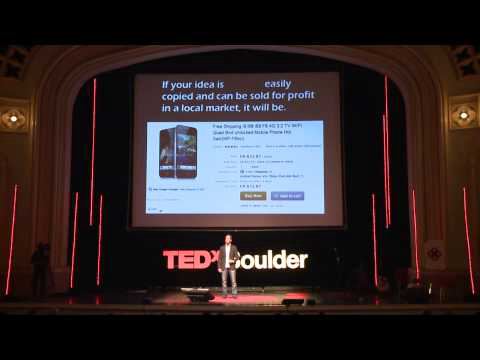
I come from the world of electronics slightly complex world I started as an engineering student and as an engineering student they tell you that real engineers come up with an idea and patent that idea so freshman year of college I told myself that I would have a patent by the time I was thirty goal I graduated started coming up with ideas and to sell those ideas I started this crazy company called spark fun electronics this is the website and we started to sell those ideas got a little bigger and a little crazier and if you don't know about spark from electronics we sell the bits to allow you to build a prototype for a project and I'm going to give you some examples of some of our customers one of our customers used our product to track the flight migration of birds across North America another customer used our products to build an interactive flame art piece and another customer used our motion sensor combined with a microcontroller connected to a motor and attach that to a blender he had a problem with cats jumping up on his counter so he came up with the blender defender so this is what Sparkfun looks like this is Evan he's one of a hundred and thirty five employees at sparkfun they build over a million widgets a year right here in Colorado now as I went from starting my business to gaining getting towards the age of 30 I started looking at the products we were selling and saying okay what are we going to patent and as I looked at other businesses that had patents I didn't like what I saw there was too many businesses that had too many patents that weren't innovating they became unfit and I came up with this idea of intellectual property obesity this is a company that has patents that no longer innovate they've become unfit I'll give you an example this is a patent from 1978 for the electronics still camera filed by a company you may have heard of Eastman Kodak Kodak had the 25-year head start in front of a billion dollar industry what did they do with that patent they they sat on it they licensed it and they went after anyone who infringed upon it and this is a graph of two companies the stock price one is Canon and one is Kodak I'll let you guess which one is which and if you hadn't heard in the news recently Kodak has recently filed for bankruptcy how did the company how did this happen to such a large amazing company I believe they became unfit what large companies like Kodak didn't realize is that if your idea is unique easily copied and can be sold for profit it will be it's actually not this good this is the sugar-coated version because unique ideas aren't the only ones that copied and it doesn't matter whether it's easily are hard to copy and it doesn't matter if you can sell the idea for profit and come on we all know the internet doesn't allow for local markets if your idea can be sold it will be let me give you some examples we've all heard of the we use one every day how many times how many different derivatives have we seen of that that's a reasonably good idea but how about a bad idea and I I don't know how many of you have an i-5 I got your beat I bought an i-9 this phone was $33 it actually makes phone calls it has Wi-Fi it has Bluetooth a complex device is just as easily copied as a simple device Instagram an amazing idea that posted no revenues yet was copied time and time again and again with the internet I can sell my product just as easily in South Africa as I can here in Colorado if your idea can be sold it will be whoa hold on you're scaring me there's this is this is why there's patents right this is why we come up with a technology and patent it say you've got an idea for new technology it costs 30 to 50 thousand dollars to file that paperwork with a with an attorney it then takes three to five years for the US Patent and Trade Office to even give you a decision on whether or not you should get a patent now I don't know about you but think about how much has changed in the past three years how much will technology change in the next three and this might be a good moment to remind you that US patents only apply in the US you're gonna need a patent in every other country now sure maybe you could get an international patent maybe you want to do this but it costs more money than I've got I'd rather spend my time building stuff and I certainly don't have the stomach to litigate in every other country that's when I discovered open-source you may thank you you may have heard of open-source software it runs your phones it runs the Internet open-source hardware is a little different it's for physical goods the first step to open-source hardware is that you come up with an idea and you share the plans with all your friends and then you tell them that they can go ahead take your idea and modify it it's totally ok and you can even sell my idea for profit now look at those three rules that's gonna happen no matter what whether you've got a patent or not folks are going to reverse engineer your idea they're gonna modify and they're gonna sell it open source hardware starts from this premise and adds only one thing and that is that any future idea will also have to be open so if you've got an idea can't be closed if it gets copied give you an example scissors let's say I come up with the idea for scissors I give you the the cad drawings with a model or whatever it takes and you're really into unicorn horns you modify it now that's a model I never was planning on selling so that's completely ok but I look at those unicorn horns and I say I wonder if I could learn something from that I bet maybe I could shrink down those horns and add some bumps to the original scissors and make for a better grip so you see we can learn from each other's improvements and all the while innovate and create a better product across multiple faces it's an example of the open-source Geiger counter or the best examples I've seen in open source hardware the Fukushima nuclear disaster was a tremendous loss and many of the local citizens after it occurred wanted to find out just how much radiation was around them and in their food supply to do this you need something called a Geiger counter a tool that measures radioactivity the problem was is that in Fukushima shortly after the disaster these tools were not available they were expensive and they were out of date hadn't changed in 25 years so a few engineers got together and started talking about how they could build a better open-source how to build a better Geiger counter they made an open-source they shared it with the community and local residents in Japan were able to build a cheaper better Geiger counter that they could actually get their hands on that's the power of open source hardware so you know of course I love open source hardware these are the reasons first it's a community good I can learn from you and you can learn for me it's where humans I believe started from sharing second this is capitalism with a capital C if more companies are competing for the same amount of customers you're going to see better quality lower prices and more features and lat and third of all it makes businesses focus my company builds electronics that's all we can do that's we have to focus every day on what we're doing and lastly especially at Sparkfun we have to innovate our products have 12 weeks on average before they're copied by our competition 12 weeks I don't have five years I don't have 10 years we have to constantly innovate and come up with something new so if your idea can be sold where do we go from here I believe you have a decision to make are you going to try to stop every company and every entity that copies your idea or are you going to find other ways to create value that's harder to duplicate now you may think I'm naive you may think I'm crazy and that an open-source hardware company is unsustainable that's okay myself my hundred and thirty five employees seventy-five million in revenue and four hundred and thirty-one unpatented products wish you the best of luck
- from
- Open Hardware
- added
- 2026-10-10
- likes
- 0
Open Hardware › Talks: “TEDx talk by Nathan Seidle.”