Pragmatic Language Interpretation as Probabilistic Inference
Trends in Cognitive Sciences, 2016. [All Versions]. Understanding language requires more than the use of fixed conventions and more than decoding combinatorial structure. Instead, comprehenders make exquisitely sensitive inferences about what utterances mean given their…
- from
- AGI & CoCoSci
- added
- 2026-10-10
- likes
- 0
similar
-
Predicting Pragmatic Reasoning in Language Games science.org
Science, 2012. [All Versions]. [Preprint]. One of the most astonishing features of human language is its capacity to convey information efficiently in context. Many theories provide informal accounts of communicative inference, yet there have been few successes in making…
-
Pragmatic Reasoning through Semantic Inference cocolab.stanford.edu
Semantics & Pragmatics, 2016. [All Versions].
-
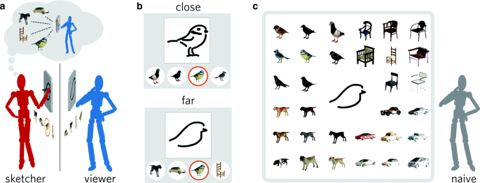
Pragmatic Inference and Visual Abstraction Enable Contextual Flexibility During Visual Communication link.springer.com
Computational Brain & Behavior, 2020. [All Versions]. A computational account on the rational behavior in graphical language games.
-
-
From Word Models to World Models: Translating from Natural Language to the Probabilistic Language of Thought arxiv.org
2023. [All Versions]. Rational meaning construction, a computational framework for language-informed thinking that combines neural language models with probabilistic models for rational inference. Linguistic meaning is framed as a context-sensitive mapping from natural language…
-
Pragmatics plato.stanford.edu
Plato Stanford. A computational philosophy account of Pragmatics, whilch studies utterances in specific contexts.


AGI & CoCoSci › Papers > Communications > Pragmatics: “Trends in Cognitive Sciences, 2016. [All Versions]. Understanding language requires more than the use of fixed conventions and more than decoding combinatorial structure. Instead, comprehenders make exquisitely sensitive inferences about what utterances mean given their…”