A Language for Counterfactual Generative Models
ICML'21, 2021. [All Versions]. [Project]. This paper presents Omega, a probabilistic programming language with support for counterfactual inference. This feature is accomplished by introducing a new operator to probabilistic programming akin to Pearl’s do.
- from
- AGI & CoCoSci
- added
- 2026-10-10
- likes
- 0
similar
-
-
A Logic Programming Language for Computational Nucleic Acid Devices pubs.acs.org
ACS Synthetic Biology, 2018. [All Versions]. This paper presents a logic programming language that allows a broad range of computational nucleic acid systems to be designed and analyzed. The language extends standard logic programming with a novel equational theory to express…
-
Leveraging Language for Abstraction and Program Search vigilworkshop.github.io
ICML'20, 2020. [All Versions].
-
From Word Models to World Models: Translating from Natural Language to the Probabilistic Language of Thought arxiv.org
2023. [All Versions]. Rational meaning construction, a computational framework for language-informed thinking that combines neural language models with probabilistic models for rational inference. Linguistic meaning is framed as a context-sensitive mapping from natural language…
-
Synthesizing theories of human language with Bayesian program induction cap.csail.mit.edu
Nature Communications, 2022. [All Versions].
-
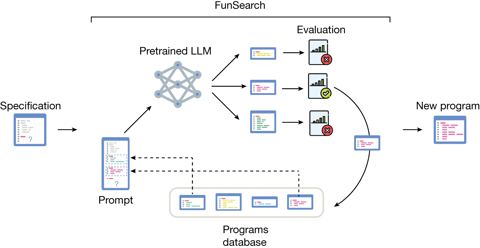
Mathematical discoveries from program search with large language models nature.com
Nature, 2024. [All Versions]. Large language models (LLMs) have demonstrated tremendous capabilities in solving complex tasks, from quantitative reasoning to understanding natural language. However, LLMs sometimes suffer from confabulations (or hallucinations), which can result…

AGI & CoCoSci › Papers > Domain Specific Language > Declarative DSL Applications: “ICML'21, 2021. [All Versions]. [Project]. This paper presents Omega, a probabilistic programming language with support for counterfactual inference. This feature is accomplished by introducing a new operator to probabilistic programming akin to Pearl’s do.”