Bayesian modeling of human–AI complementarity
Proceedings of the National Academy of Sciences, 2022. [All Versions]. A Bayesian framework for combining the predictions and different types of confidence scores from humans and machines.
- from
- AGI & CoCoSci
- added
- 2026-10-10
- likes
- 0
similar
-
Bayesian Brains without Probabilities sciencedirect.com
Trends in Cognitive Sciences, 2016. [All Versions]. A perspective on human probabilistic modeling without explicit probabilistic computation.
-
Synthesizing theories of human language with Bayesian program induction nature.com
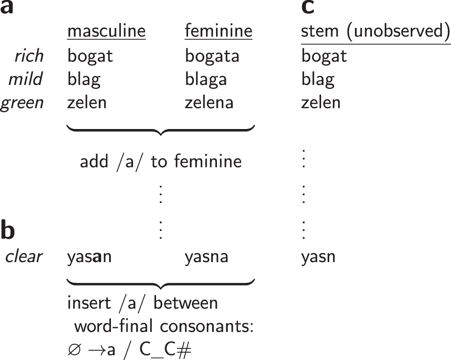
Nature Communications, 2022. [All Versions]. Automated, data-driven construction and evaluation of scientific models and theories is a long-standing challenge in artificial intelligence. This work presents a framework for algorithmically synthesizing models of a basic part of…
-
Synthesizing theories of human language with Bayesian program induction cap.csail.mit.edu
Nature Communications, 2022. [All Versions].
-
Bayesian modeling of human concept learning proceedings.neurips.cc
NeurIPS'98, 1998. [All Versions]. [Preprint]. This work considers the problem of learning concepts from small numbers of positive examples, a feat which humans perform routinely but which computers are rarely capable of. Bridging machine learning and cognitive science…
-
Where do hypotheses come from? sciencedirect.com
Cognitive Psychology, 2017. [All Versions]. [Preprint]. Why are human inferences sometimes remarkably close to the Bayesian ideal and other times systematically biased? In particular, why do humans make near-rational inferences in some natural domains where the candidate…
-
Computational rationality: A converging paradigm for intelligence in brains, minds, and machines gershmanlab.com
Science, 2015. [All Versions]. A comprehensive review on the rationality of Bayesian computational models.
AGI & CoCoSci › Papers > Explainability > Trustworthy AI: “Proceedings of the National Academy of Sciences, 2022. [All Versions]. A Bayesian framework for combining the predictions and different types of confidence scores from humans and machines.”