Understanding Human Intelligence through Human Limitations
Trends in Cognitive Sciences, 2020. [All Versions]. [Preprint]. Recent progress in artificial intelligence provides the opportunity to ask the question of what is unique about human intelligence, but with a new comparison class. The author argues that we can understand human…
- from
- AGI & CoCoSci
- added
- 2026-10-10
- likes
- 0
similar
-
Evaluating and Modeling Social Intelligence: A Comparative Study of Human and AI Capabilities escholarship.org
CogSci'24, 2024. [All Versions]. This work eveloped a comprehensive theoretical framework for social dynamics and introduced two evaluation tasks: Inverse Reasoning (IR) and Inverse Inverse Planning (IIP). The approach also encompassed a computational model based on recursive…
-
Exploring human cognition using large image databases cocosci.princeton.edu
Topics in Cognitive Sciences, 2016. [All Versions].
-
Is human cognition adaptive? act-r.psy.cmu.edu
Behavioral and Brain Sciences, 1991. [All Versions]. The original paper introducing the adaptation perspective of human intelligence, the theoretical basis of the ACT cognitive architecture.
-
Cognitive engineering: Human problem solving with tools researchgate.net
Human Factors, 1988. [All Versions]. The original idea of investigating huamn tool use in problem solving.
-
The Child as Hacker cell.com
Trends in Cognitive Sciences, 2020. [All Versions]. The scope of human learning and development poses a radical challenge for cognitive science. The authors propose that developmental theories can address this challenge by adopting perspectives from computer science. Many of…
-
Building machines that learn and think with people nature.com
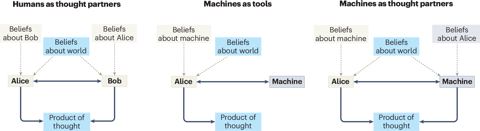
Nature Human Behavior, 2024. [All Versions]. [Preprint]. This perspective shows how the science of collaborative cognition can be put to work to engineer systems that really can be called ‘thought partners’, systems built to meet humans' expectations and complement humans…
AGI & CoCoSci › Papers > Meta-Level Considerations > Rationality: “Trends in Cognitive Sciences, 2020. [All Versions]. [Preprint]. Recent progress in artificial intelligence provides the opportunity to ask the question of what is unique about human intelligence, but with a new comparison class. The author argues that we can understand human…”