Probabilistic models of cognition: Conceptual foundations
Trends in Cognitive Sciences, 2006. [All Versions]. Remarkable progress in the mathematics and computer science of probability has led to a revolution in the scope of probabilistic models. In particular, ‘sophisticated’ probabilistic methods apply to structured relational…
- from
- AGI & CoCoSci
- added
- 2026-10-10
- likes
- 0
similar
-
Bayesian Brains without Probabilities sciencedirect.com
Trends in Cognitive Sciences, 2016. [All Versions]. A perspective on human probabilistic modeling without explicit probabilistic computation.
-
Bridging Levels of Analysis for Probabilistic Models of Cognition cocosci.princeton.edu
Current Directions in Psychological Science, 2012. [All Versions]. A Marr's paradigm account on probabilistic models.
-
Computational rationality: A converging paradigm for intelligence in brains, minds, and machines gershmanlab.com
Science, 2015. [All Versions]. A comprehensive review on the rationality of Bayesian computational models.
-
Coalescing the Vapors of Human Experience into a Viable and Meaningful Comprehension escholarship.org
CogSci'16, 2016. [All Versions]. Models of concept learning and theory acquisition often invoke a stochastic search process, in which learners generate hypotheses through some structured random process and thenevaluate them on some data measuring their quality or value. To be…
-
Theory-based Bayesian models of inductive learning and reasoning cell.com
Trends in Cognitive Sciences, 2006. [All Versions]. [Preprint]. Inductive inference allows humans to make powerful generalizations from sparse data when learning about word meanings, unobserved properties, causal relationships, and many other aspects of the world. Traditional…
-
Probabilistic machine learning and artificial intelligence nature.com
Nature, 2015. [All Versions]. Probabilistic modelling provides a framework for understanding what learning is, and has therefore emerged as one of the principal theoretical and practical approaches for designing machines that learn from data acquired through experience. The…
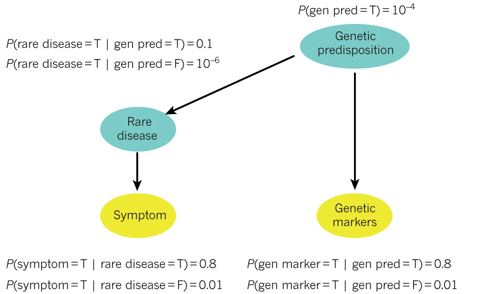
AGI & CoCoSci › Papers > Abduction > Explanation: “Trends in Cognitive Sciences, 2006. [All Versions]. Remarkable progress in the mathematics and computer science of probability has led to a revolution in the scope of probabilistic models. In particular, ‘sophisticated’ probabilistic methods apply to structured relational…”