From Explicit Communication to Tacit Cooperation: A Novel Paradigm for Cooperative MARL
AAMAS'24, 2024. [All Versions]. Drawing inspiration from human team cooperative learning, this paper proposes a novel paradigm that facilitates a gradual shift from explicit communication to tacit cooperation.
- from
- AGI & CoCoSci
- added
- 2026-10-10
- likes
- 0
similar
-
Multi-Agent Cooperation and the Emergence of (Natural) Language arxiv.org
ICLR'17, 2017. [All Versions]. The original paper on the emergence of language in multi-agent reinforcement learning.
-
Theory of Minds: Understanding Behavior in Groups through Inverse Planning aaai.org
AAAI'19, 2019. [All Versions]. Towards the goal of building machine-learning algorithms with human-like social intelligence, this paper develops a generative model of multiagent action understanding based on a novel representation for these latent relationships called…
-
JARVIS-1: Open-World Multi-Task Agents With Memory-Augmented Multimodal Language Models ieeexplore.ieee.org
IEEE Transactions on Pattern Analysis and Machine Intelligence. [All Versions]. Achieving human-like planning and control with multimodal observations in an open world is a key milestone for more functional generalist agents. Existing approaches can handle certain long-horizon…
-
-
Leveraging Language for Abstraction and Program Search vigilworkshop.github.io
ICML'20, 2020. [All Versions].
-
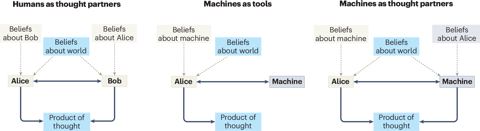
Building machines that learn and think with people nature.com
Nature Human Behavior, 2024. [All Versions]. [Preprint]. This perspective shows how the science of collaborative cognition can be put to work to engineer systems that really can be called ‘thought partners’, systems built to meet humans' expectations and complement humans…

AGI & CoCoSci › Papers > Communications > Coordination: “AAMAS'24, 2024. [All Versions]. Drawing inspiration from human team cooperative learning, this paper proposes a novel paradigm that facilitates a gradual shift from explicit communication to tacit cooperation.”